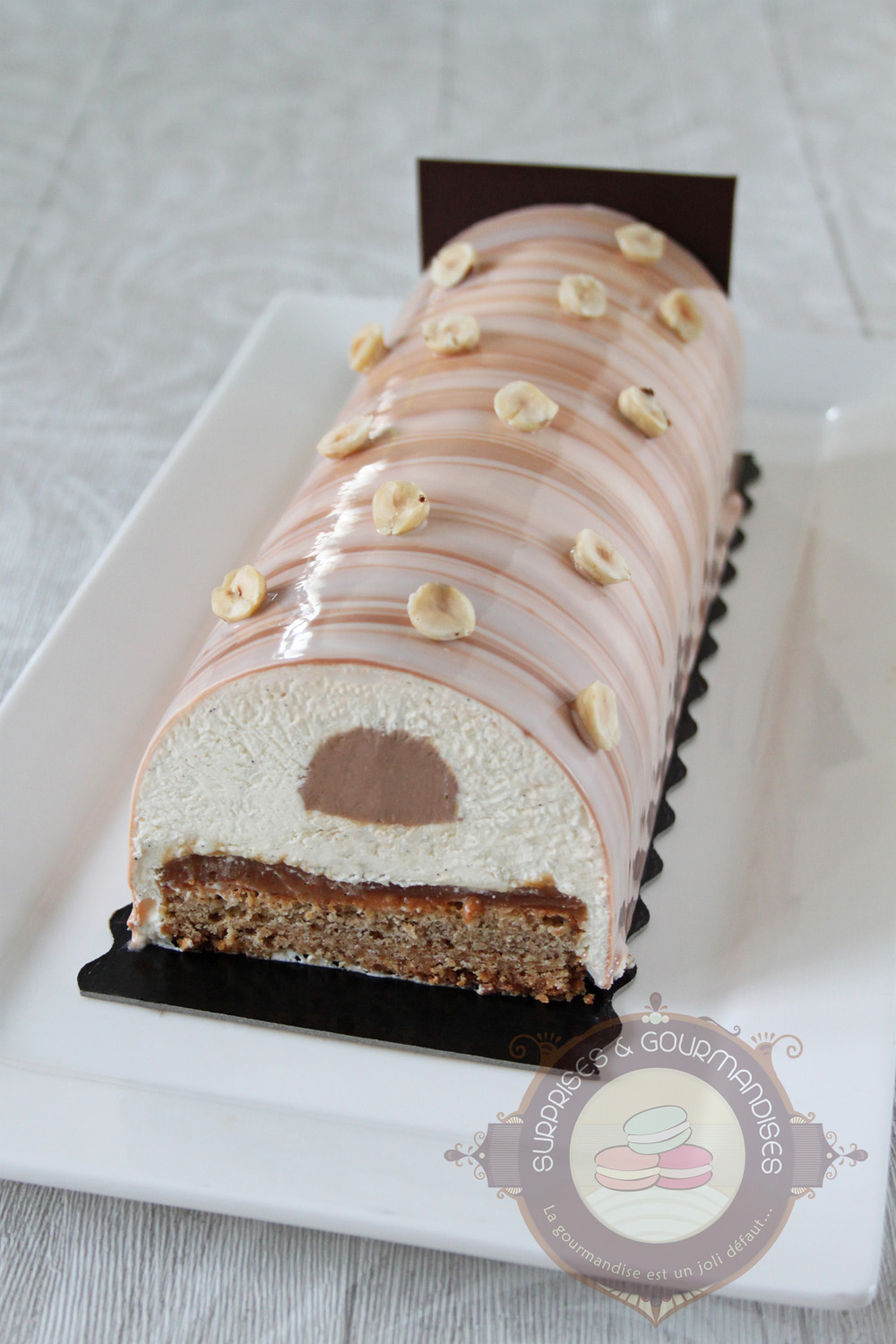



In my previous article, I told you that the weekend was reserved for publishing a Christmas recipe. It would be a bit much to do otherwise on the first of December, wouldn’t it? So, as promised, here’s a new Yule log recipe, made last year: a vanilla, hazelnut and caramel Yule log. Flavours loved by (almost) everyone, which I’m sure will delight you.
For the glaze, I wanted to try something different. Last year, I took part in a pastry course with Cake ta life, where we made several entremets (and several mirror glazes, of course). I told you about it in this article. We’d asked Morgane to show us how to make a tiger-striped glaze. Needless to say, I put everything I learned on that course to use very quickly. Honestly, it’s not difficult to do, but you first need to master the mirror glaze, and I know that’s the bête noire of many of you (and I understand).
If you really don’t want to make a mirror glaze, it’s not a problem; you can just as well buy a ready-to-use velvet spray can (I’d go for white personally) and spray your dessert with it.
I’ll take this opportunity to answer a question many of you are asking. Yes, you can start your Yule logs right now. These are entremets that can wait in the freezer for a few weeks. When you take the entremets out of its mould, wrap it in cling film (I also put it in a freezer bag) and all that’s left is to do the decoration (velvet spray, mirror glaze…). For Christmas Eve, take the Yule log out in the morning (even at midday is no problem, since generally dessert isn’t eaten at 9pm!), do the decoration and leave the Yule log in the fridge until the evening. In short, as you’ll have gathered, you just need to organise yourself in advance!
Ingredients & Method
9 components · Full recipe
Tiger mirror glaze (can be made in advance)
Ingredients
- 150 g (5.3 oz) glucose
- 150 g (5.3 oz) sugar
- 75 ml (2.5 fl oz) water
- 150 g (5.3 oz) white chocolate
- 100 g (3.5 oz) unsweetened condensed milk
- 10 g (0.4 oz) powdered gelatin
- 60 g (2.1 oz) water (to rehydrate the gelatin)
- white food colouring
- brown food colouring
Method
1
Ideally, make the glaze the day before (or in advance) and reheat it in the microwave when needed.
2
Rehydrate the gelatin in the water.
3
In a saucepan, combine the water, sugar and glucose and heat to 103°C / 217°F.
4
Meanwhile, in a tall jug, place the white chocolate cut into pieces, the unsweetened condensed milk and the rehydrated gelatin.
5
When the water/sugar/glucose mixture reaches 103°C / 217°F, pour it into the jug and blend with an immersion blender to smooth the glaze, taking care not to incorporate any air (which would create unsightly bubbles).
6
Divide the glaze in two. Add a little white food colouring to the first portion and brown food colouring to the second. Blend each with an immersion blender.
7
If necessary, pass both glazes through a fine sieve and store in the fridge in two separate containers. I recommend dividing the glaze in the jug: pour half, add white colouring, blend and transfer to a small bowl. No need to wash the jug — add the remaining half with the brown colouring, blend and transfer to a second bowl.
Custard base (for the gianduja cream — make the day before)
Ingredients
- 125 g (4.4 oz) heavy cream
- 125 g (4.4 oz) milk
- 50 g (1.8 oz) egg yolks
- 25 g (0.9 oz) sugar
- 2 g (0.1 oz) gelatin (1 sheet)
Method
1
Soak the gelatin sheet in cold water.
2
In a small saucepan, heat the milk and cream together.
3
In a bowl, whisk the egg yolks with the sugar.
4
Pour the hot milk-cream mixture over the yolk-sugar mixture, whisk well and return everything to a gentle heat.
5
Cook to 83°C / 181°F, stirring constantly with a spatula in a figure-of-eight motion. Be careful not to let the cream boil (which would cause the eggs to curdle).
6
Off the heat, add the squeezed-out gelatin. Pass through a fine sieve and set aside. To prevent a skin from forming, stir the custard from time to time.
Gianduja cream (make the day before)
Ingredients
- 125 g (4.4 oz) milk gianduja (Valrhona, or homemade)
- 125 g (4.4 oz) custard (see recipe above)
Method
1
Cut the gianduja into pieces and melt it in a bain-marie or in the microwave.
2
Pour the hot custard over the melted gianduja in three additions, as for a ganache, using a spatula.
3
Emulsify the mixture with an immersion blender.
4
Pour into a yule log insert mould, leave to cool slightly, then freeze overnight.
Hazelnut streusel
Ingredients
- 40 g (1.4 oz) butter
- 40 g (1.4 oz) light brown sugar
- 50 g (1.8 oz) toasted hazelnut powder
- 40 g (1.4 oz) flour
- 0.5 g (0 oz) fleur de sel
Method
1
In a bowl, mix the softened butter, light brown sugar, sifted flour, hazelnut powder and fleur de sel together until you get a smooth, homogeneous dough ball.
2
Roll the dough out to 3–4 mm thickness between two sheets of baking paper.
3
Leave to rest in the fridge for half an hour.
4
Preheat the oven to 160°C / 325°F.
5
Cut out a 16×16 cm (6.3 in) square using a pastry frame. Leave the frame in place and bake for 15 minutes.
Hazelnut soft cake
Ingredients
- 50 g (1.8 oz) hazelnut powder
- 30 g (1.1 oz) light brown sugar
- 50 g (1.8 oz) egg
- 11 g (0.4 oz) icing sugar
- 11 g (0.4 oz) heavy cream
- zest of 1 lemon
- 47 g (1.7 oz) butter
- 25 g (0.9 oz) flour
- 2.8 g (0.1 oz) baking powder
- 50 g (1.8 oz) egg white
- 8.3 g (0.3 oz) light brown sugar
Method
1
While the streusel is baking, prepare the hazelnut soft cake batter.
2
In a bowl, mix together the toasted hazelnut powder, lemon zest, light brown sugar, egg, icing sugar and heavy cream.
3
In a saucepan, cook the butter until it turns a hazelnut colour (keep stirring). The butter is ready when it smells deliciously nutty and stops sizzling. Add it still hot to the rest of the ingredients, stirring continuously.
4
Fold in the sifted flour and baking powder.
5
Whip the 50 g (1.8 oz) egg whites to stiff peaks, tightening them with the 8.3 g (0.3 oz) light brown sugar, then gently fold into the first mixture using a spatula. Do not overwork the batter to avoid deflating the egg whites.
6
Pour the batter over the streusel, being careful not to overfill (the biscuit will rise during baking).
7
Bake again for 15 minutes at 180°C / 350°F. Remove from the oven and leave to cool on a wire rack (keep the frame in place).
Smooth vanilla caramel (can be made in advance)
Ingredients
- 95 g (3.4 oz) sugar
- 50 g (1.8 oz) + 100 g (3.5 oz) glucose
- 50 g (1.8 oz) milk
- 1 vanilla pod
- 200 g (7.1 oz) heavy cream
- 2 g (0.1 oz) fleur de sel
- 70 g (2.5 oz) butter
Method
1
In a small saucepan, heat the cream, milk, 50 g (1.8 oz) of glucose, the vanilla pod and fleur de sel together.
2
In a separate saucepan, cook the sugar and the remaining 100 g (3.5 oz) of glucose to 185°C / 365°F.
3
Off the heat, deglaze with the hot cream mixture. Be careful of splashing.
4
Return to the heat and cook to 105°C / 221°F, stirring constantly with a spatula. Pass through a fine sieve if needed.
5
Let the caramel cool slightly and, when it reaches 70°C / 158°F, add the butter cut into small pieces. Blend with an immersion blender.
6
Pour the caramel over the streusel/soft cake base to a depth of approximately 5 mm (the pastry frame should still be in place).
7
Place the biscuit base in the freezer. Store the remaining caramel in an airtight jar — it keeps for a few weeks in the fridge.
8
Once the caramel is fully set, cut the square in half to give two rectangles. Trim them lengthways to fit the length of your yule log mould.
Ivory vanilla mousse
Ingredients
- 116 g (4.1 oz) heavy cream
- 1 vanilla pod
- 116 g (4.1 oz) white chocolate
- 2.5 g (0.1 oz) powdered gelatin
- 15 g (0.5 oz) water (to rehydrate the gelatin)
- 250 g (8.8 oz) heavy cream
Method
1
Rehydrate the gelatin in the water.
2
Make a ganache: melt the white chocolate in a bain-marie until just starting to melt.
3
Heat the 116 g (4.1 oz) of cream with the vanilla seeds and pod. Leave to infuse for about ten minutes, covered.
4
Reheat the cream, then off the heat add the squeezed-out gelatin.
5
Pour the cream over the white chocolate in three additions, emulsifying each time. The ganache should be smooth and glossy.
6
Whip the 250 g (8.8 oz) of heavy cream but don’t over-whip — it should be light and mousse-like.
7
When the ganache has cooled to 30°C / 86°F, gently fold in the whipped cream, then set aside.
Vanilla, hazelnut and caramel yule log assembly
Ingredients
- None
Method
1
Pour three-quarters of the vanilla mousse into the yule log mould, spreading it up the sides with a spatula for a clean finish. Place in the freezer for 5 minutes if needed to let the mousse set slightly.
2
Remove the gianduja cream insert from the freezer and gently press it into the mousse, centred.
3
Add the remaining vanilla mousse, leaving about two centimetres of space, then press in the streusel/soft cake/caramel base with the caramel side facing the mousse.
4
Smooth the surface with a spatula.
5
Cover with cling film and freeze overnight.
Vanilla, hazelnut and caramel yule log decoration
Ingredients
- a few toasted hazelnut halves
- dark chocolate (for tempering and making yule log end decorations)
Method
1
Remove the entremet from the freezer and unmould it.
2
Place the frozen entremet on a wire rack set over a plate or tray to catch any excess glaze.
3
Reheat both mirror glazes to approximately 30°C / 86°F. In a jug, pour the white glaze then add the brown glaze. Using a spoon or spatula, give it a very quick stir — just one fast swipe (the glaze must on no account be homogeneous).
4
Gently pour the glaze to cover the entremet entirely, moving back and forth across the full width of the yule log.
5
Carefully lift the entremet off the wire rack and place it on a serving dish.
6
Decorate as you like, then leave to thaw in the refrigerator. Allow at least 5–6 hours for defrosting.

Gallery