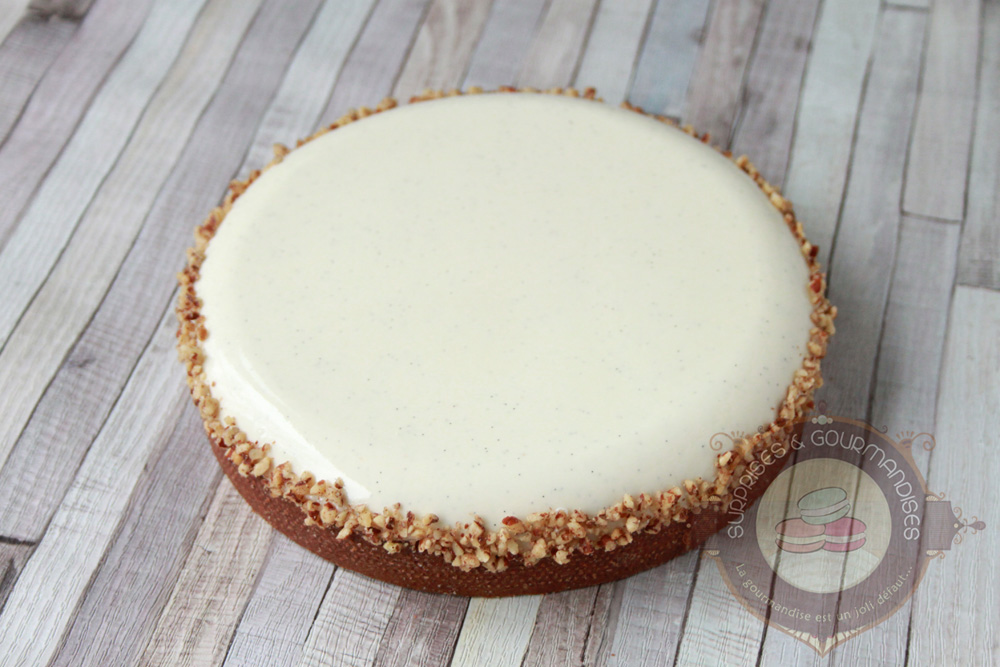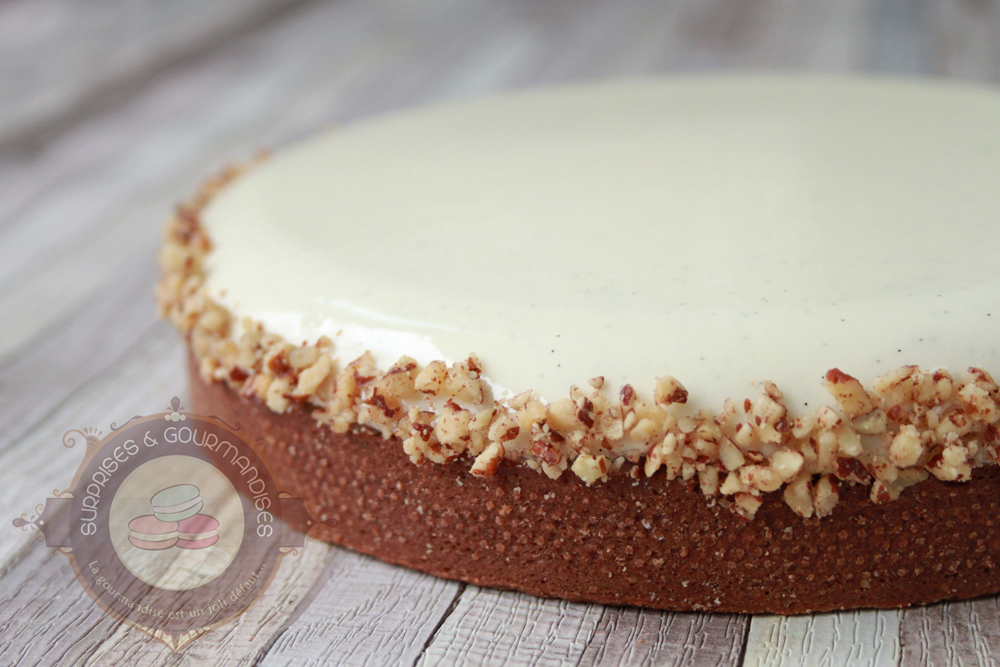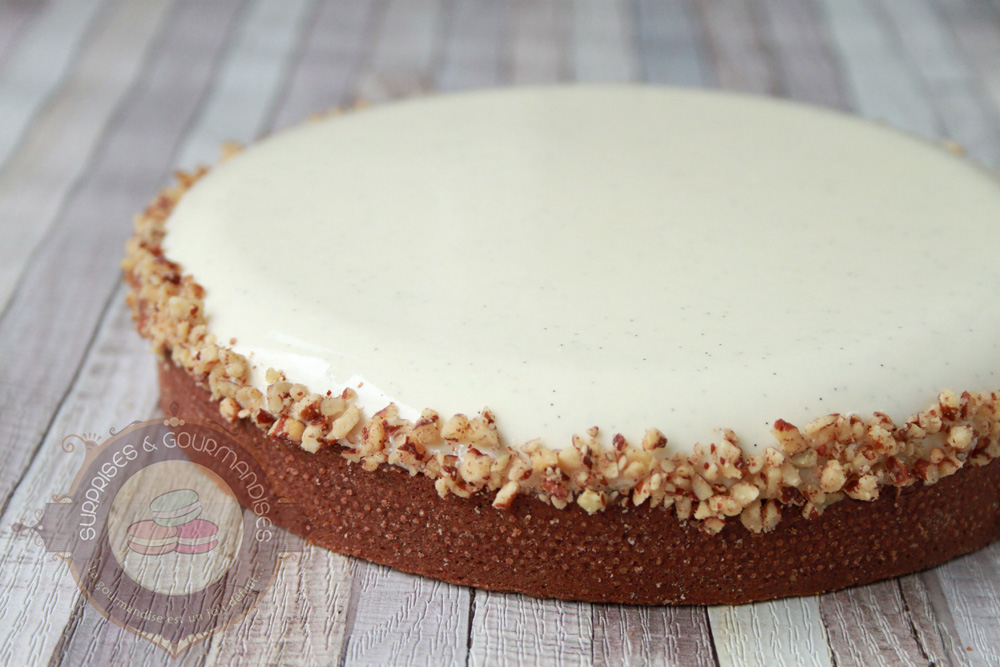


Here is a recipe that was a resounding success on Instagram. So I hurried to write up the recipe for you to satisfy your craving for indulgence.
And yet, it’s a dessert that was thrown together completely on the fly to clear out my freezer a bit. True story!
The disc of vanilla mousse was already ready (left over from a previous recipe) and so was my pâte sucrée. I had frozen it baked. All I had to do was come up with a recipe using these 2 elements. I went for a hazelnut and vanilla pairing that I’m particularly fond of.
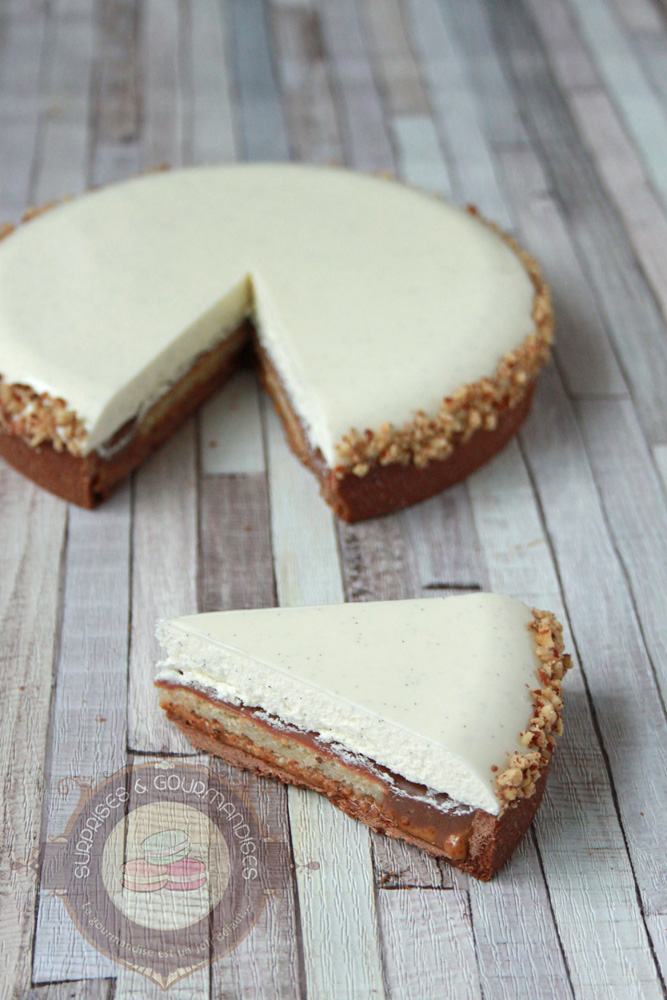
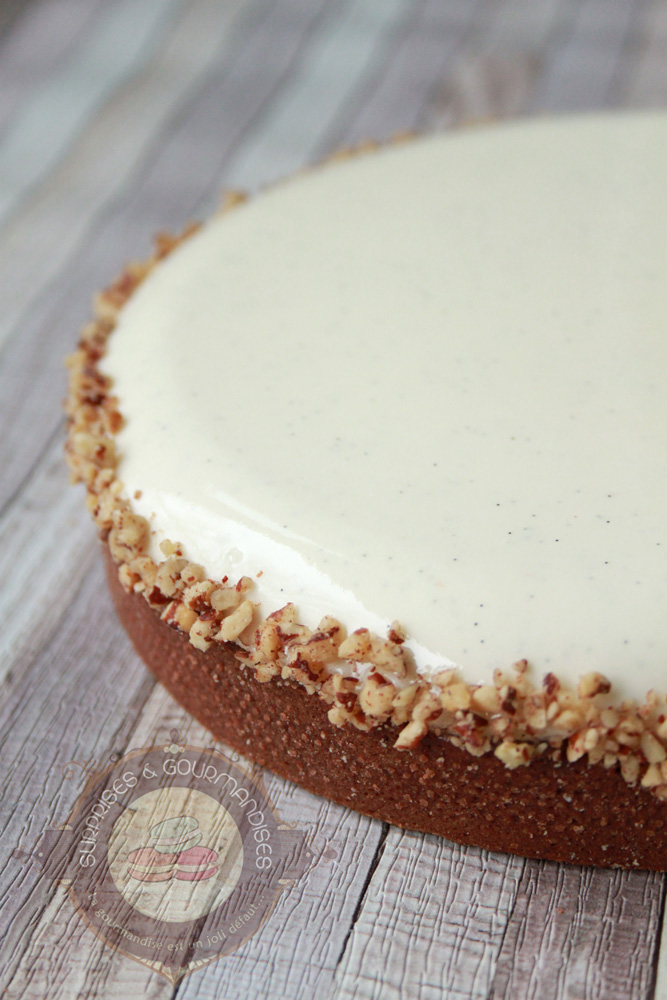
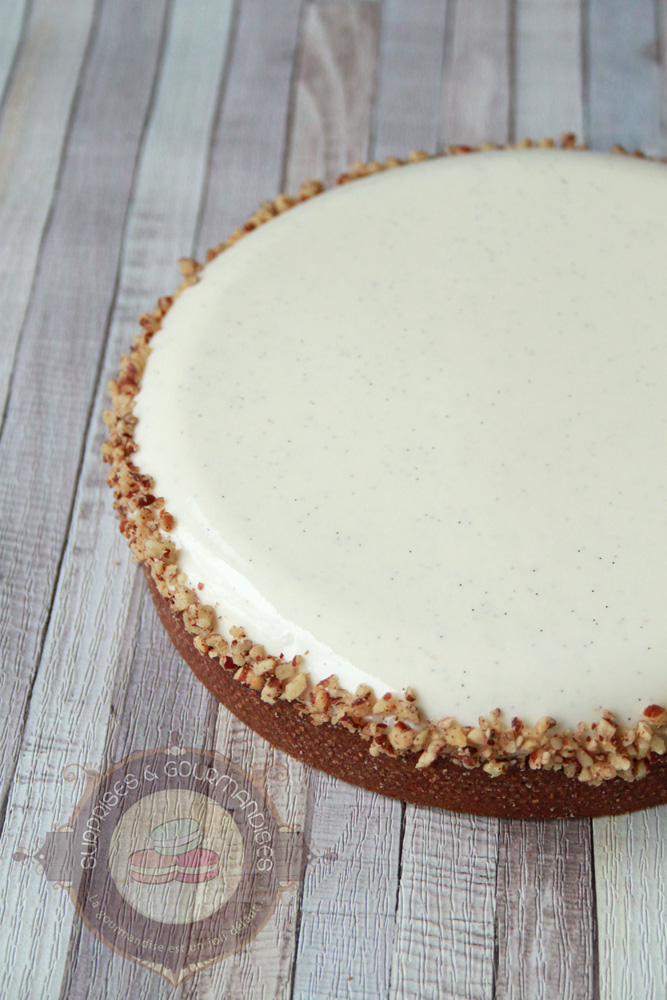
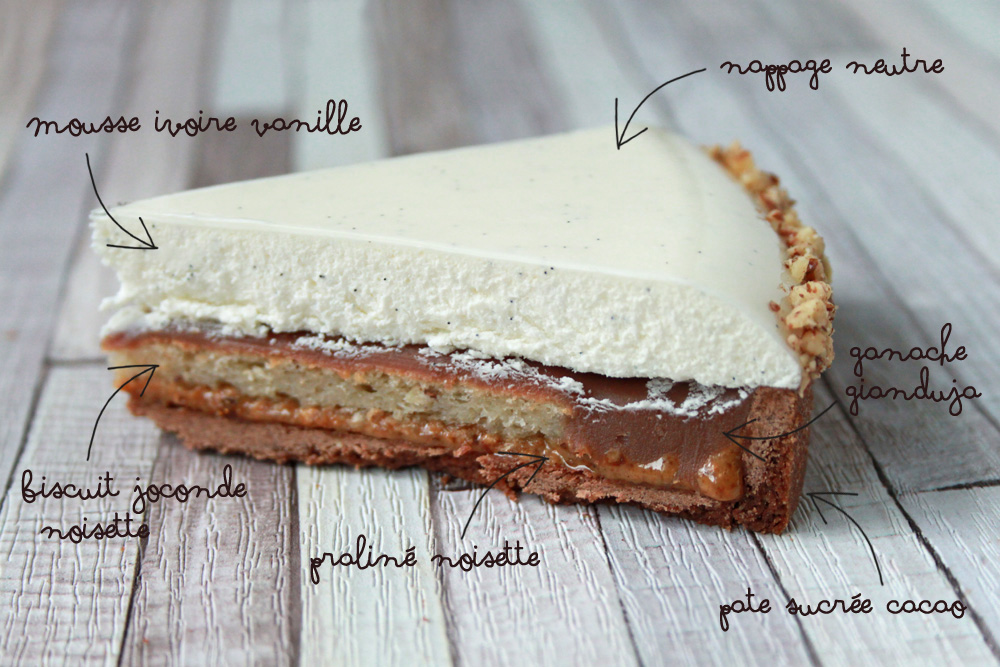
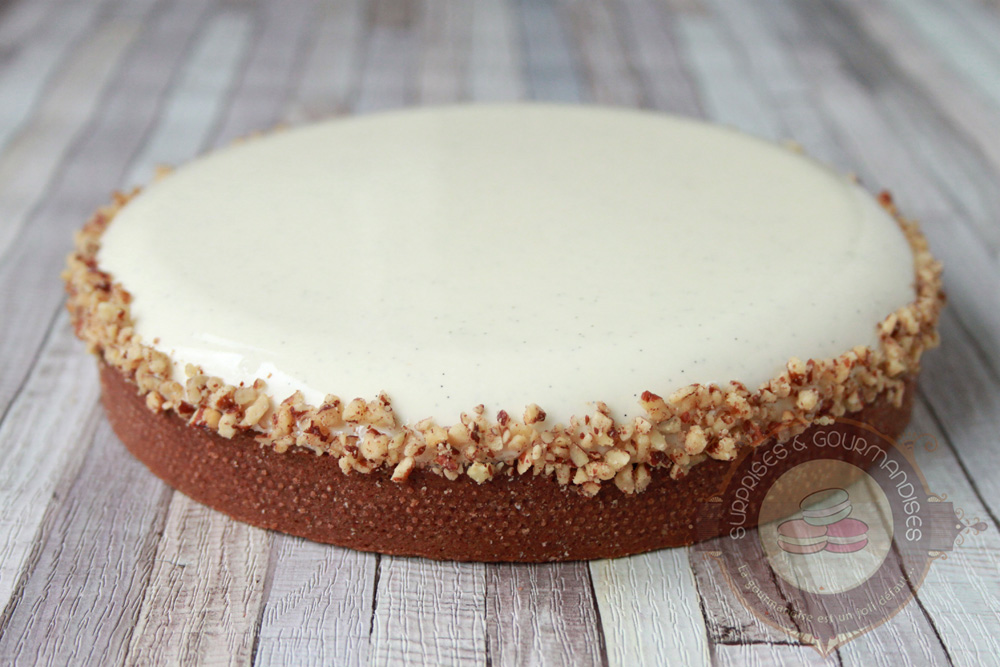
This hazelnut and vanilla tart-entremets is therefore made up of a cocoa pâte sucrée, 100% hazelnut praline, a hazelnut joconde sponge, a gianduja ganache and a vanilla ivoire mousse.
When it came to tasting, success guaranteed! It’s terribly indulgent and not too sweet (don’t put too much praline in the bottom of your tart all the same, even if it’s divine, it adds sugar). Ideally, I would have liked more gianduja ganache (you can see it when it’s cut), my joconde sponge was perhaps a tiny bit too thick.
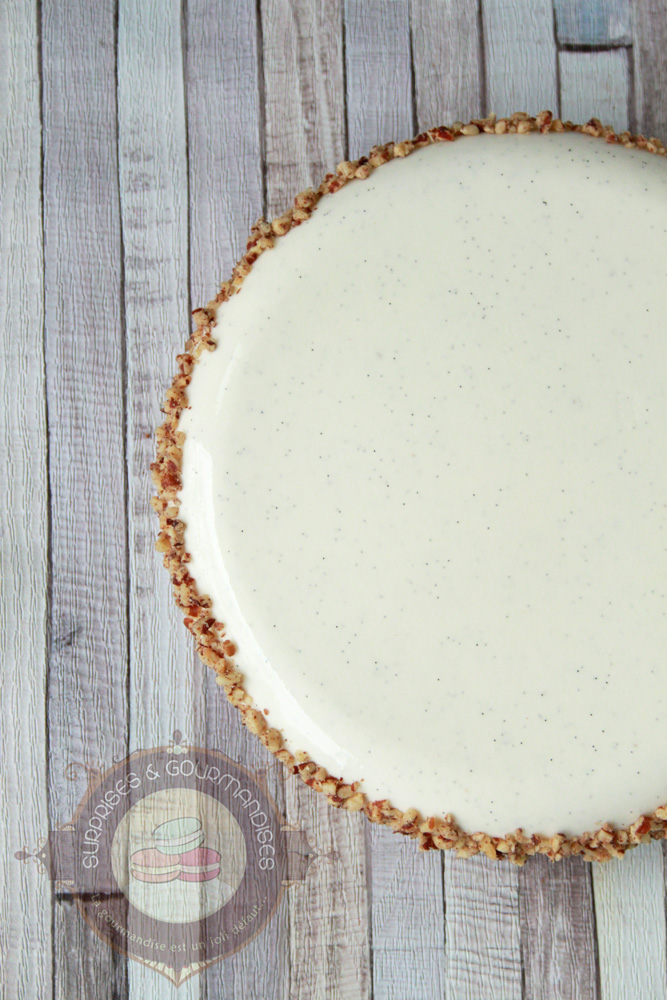
Regarding the assembly of the tart, you should know that my disc of vanilla mousse is 18 cm in diameter (I used the Eclipse mould from Silikomart) and so is my pâte sucrée, or even a touch less since it shrinks slightly and comes away from the ring by itself during baking. When I placed the disc of vanilla mousse on the tart, it didn’t fit perfectly (despite appearances), the vanilla mousse overhung slightly. That said, once the chopped hazelnuts were placed all around, it wasn’t so much of a problem anymore. All the same, I advise you to make a 20 cm diameter pâte sucrée so as not to have this slight mismatch (have a look at my exotic tart recipe where I use a 20 cm diameter tart base and still the Eclipse mould, that’ll give you an idea).
As for the decoration, it’s pared-back and that suits me just fine. I’ve become a fan of neutral glaze, which keeps the white colour of the mousse (for that, you need a good chocolate, I recommend Valrhona’s Ivoire or Opalys or, like me, Cacao Barry’s Zéphyr) and the vanilla seeds. This neutral glaze (which is very easy to make on top of that: water, sugar and gelatine) pours very easily in a fairly thin layer, so I see nothing but advantages!
Ingredients & method
7 components · Full recipe
Hazelnut praline (can be made ahead)
Ingredients
- 150 g (5.3 oz) hazelnuts
- 100 g (3.5 oz) sugar
- 25 g (0.9 oz) water
- 1 small pinch of fleur de sel
Method
1
Toast the hazelnuts in the oven for about 15 minutes at 150°C / 300°F.
2
In a heavy-bottomed saucepan or cast-iron pot, bring the water and sugar to a boil. At 116°C / 241°F, remove from the heat and pour the nuts into the hot sugar syrup, stirring to coat them completely. The mixture will turn whitish — this is perfectly normal.
3
Return to medium heat and stir constantly until the sugar melts again and caramelises (this takes about twenty minutes). Do not stop stirring, otherwise the nut mixture will burn.
4
When done, the nuts will be beautifully shiny and have taken on a lovely auburn colour. Spread them out on baking paper and leave to cool.
5
Once completely cold, break up the nut brittle and place it in a food processor along with the fleur de sel.
6
Blend, pausing regularly (to prevent the paste from overheating), until you reach a praline consistency. The longer you blend, the more liquid it becomes — you can opt for a rustic, slightly textured praline or a very smooth one.
7
Store in an airtight jar and set aside.
Ivory vanilla mousse (make the day before)
Ingredients
- 100 g (3.5 oz) full-fat double cream
- 1 vanilla pod
- 100 g (3.5 oz) white chocolate
- 2.15 g (0.1 oz) powdered gelatine
- 13 g (0.5 oz) water (to rehydrate the gelatine)
- 215 g (7.6 oz) full-fat whipping cream
Method
1
Rehydrate the gelatine in the water.
2
Make a ganache: melt the white chocolate in a bain-marie until it just starts to melt.
3
Heat the double cream with the vanilla seeds and pod. Cover and leave to infuse for about ten minutes.
4
Reheat the cream, then off the heat, add the rehydrated gelatine.
5
Pour the cream over the white chocolate in three additions, emulsifying each time. The chocolate should be smooth and glossy.
6
Whisk the whipping cream but don’t take it too far — it should be lightly whipped and mousse-like.
7
Once the ganache has cooled to 20°C / 68°F, gently fold in the whipped cream.
8
Pour the vanilla mousse into the lower half of the Eclipse mould to a depth of 1 cm (0.4 in).
Cocoa sweet pastry dough (start 2 days ahead or the day before)
Ingredients
- 150 g (5.3 oz) softened butter
- 95 g (3.4 oz) icing sugar
- 30 g (1.1 oz) ground almonds
- 60 g (2.1 oz) egg (one large egg)
- 225 g (7.9 oz) plain flour
- 25 g (0.9 oz) unsweetened cocoa powder
- a pinch of fleur de sel
Method
1
Place the softened butter and icing sugar in the bowl of a stand mixer fitted with the paddle attachment and mix on low speed. Add the ground almonds and fleur de sel and mix again.
2
Add the beaten egg and mix with a spatula this time (it’s easier than using the mixer).
3
Finish by adding the sifted flour and cocoa mixture and mix with the machine until you have a smooth ball of dough. Don’t overwork it. Bring the dough together into a ball without pressing. Divide the dough into 2 equal portions.
4
Wrap each portion in cling film, flattening them into a rectangle. Refrigerate one portion overnight and freeze the other (for a future tart). The next day, roll the pastry out to 2–3 mm thickness. Cut out a 24 cm (9.4 in) diameter disc.
5
Grease a 20 cm (7.9 in) tart ring and line it with the pastry, making sure to create a clean right angle.
6
Refrigerate for at least 6 hours (ideally).
7
Preheat the oven to 160°C / 325°F.
8
Once the pastry is very cold, trim the overhanging edges with a small knife.
9
Place a sheet of baking paper on the pastry and weigh it down with baking beads or dried beans for blind baking (normally, if the tart shell has spent the night in the fridge, the pastry won’t move and you won’t need baking beads).
10
Bake for about 30 minutes (note: it’s harder to monitor the baking of a cocoa sweet pastry due to its colour — keep a close eye on it).
Hazelnut joconde sponge (30 x 40 cm (15.7 in))
Ingredients
- 100 g (3.5 oz) icing sugar
- 50 g (1.8 oz) ground almonds
- 50 g (1.8 oz) ground hazelnuts
- 125 g (4.4 oz) whole eggs
- 20 g (0.7 oz) melted butter
- 25 g (0.9 oz) plain flour
- 125 g (4.4 oz) egg whites
- 40 g (1.4 oz) caster sugar
Method
1
Preheat the oven to 200°C / 400°F.
2
Melt the butter in the microwave and leave to cool.
3
Sift all the dry ingredients: ground almonds, ground hazelnuts, flour and icing sugar.
4
In the bowl of a stand mixer, whisk the whole eggs then add the sifted dry ingredients. Whisk for two minutes until the mixture is smooth and well combined.
5
Add the cooled melted butter and fold in gently with a spatula.
6
Meanwhile, whisk the egg whites to stiff peaks, adding the sugar in three additions once they begin to foam. Continue whisking to firm them up, then gently fold them into the previous mixture.
7
Pour the batter onto a 30 x 40 cm (15.7 in) baking tray lined with lightly greased baking paper and smooth the surface with a palette knife. If I were doing it again, I wouldn’t pour all the batter — I’d keep a small amount back to ensure the sponge isn’t too thick (see the introduction).
8
Bake for about 12 minutes. The sponge should be golden and not stick to your finger.
9
Out of the oven, turn the sponge out onto a fresh sheet of baking paper and carefully peel off the top sheet. Place the sponge on a rack and leave to cool.
10
Cut out a 14 cm (5.5 in) diameter circle. You’ll have sponge left over. You can cut a larger circle for another entremet, or small circles for individual entremets. That’s what I did (and I put them in the freezer). Otherwise, it goes down a treat with coffee 😊
Gianduja ganache
Ingredients
- 65 g (2.3 oz) whipping cream
- 20 g (0.7 oz) milk
- 165 g (5.8 oz) hazelnut milk gianduja
Method
1
Place the gianduja in a large bowl and melt it in the microwave or in a bain-marie.
2
In a small saucepan, heat the milk and cream together and bring to a boil.
3
Pour one-third of the liquid over the gianduja and stir with a spatula to create an emulsion. Add the second third, then the third, until the mixture is smooth and homogeneous.
Neutral glaze
Ingredients
- 4 g (0.1 oz) gelatine
- 24 g (0.8 oz) water (to rehydrate the gelatine)
- 80 g (2.8 oz) sugar
- 80 g (2.8 oz) water
Method
1
Rehydrate the gelatine in the water for at least 15 minutes.
2
In a saucepan, heat the sugar and water to 103°C / 217°F.
3
Off the heat, add the rehydrated gelatine and stir with a spatula, being careful not to incorporate any air.
4
Leave to cool until it reaches 32°C / 90°F.
Assembly of the hazelnut and vanilla tart-entremet
Ingredients
- None
Assembly
1
Spread the hazelnut praline over the tart shell in an even layer (not too thick, even if it’s utterly delicious!).
2
Place the joconde sponge disc in the centre of the tart and press down gently.
3
Pour over the gianduja ganache and smooth flush with an offset spatula.
4
When the neutral glaze has reached 32°C / 90°F, remove the vanilla mousse disc from the freezer and glaze it.
5
Using a large offset spatula, carefully place the mousse disc on the tart, centring it precisely.
6
Scatter crushed hazelnuts all around the mousse disc and refrigerate for 1–2 hours before serving.
Gallery