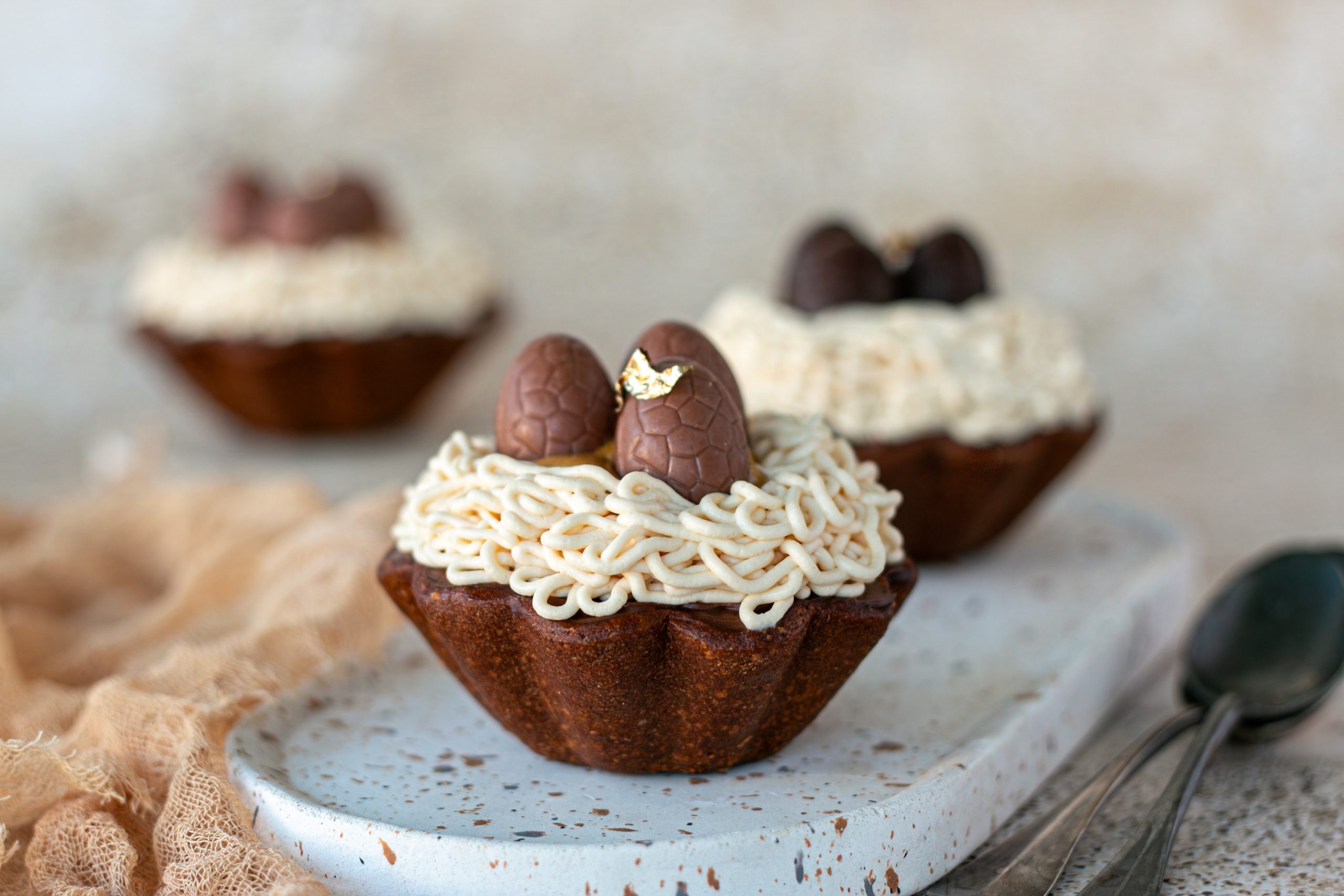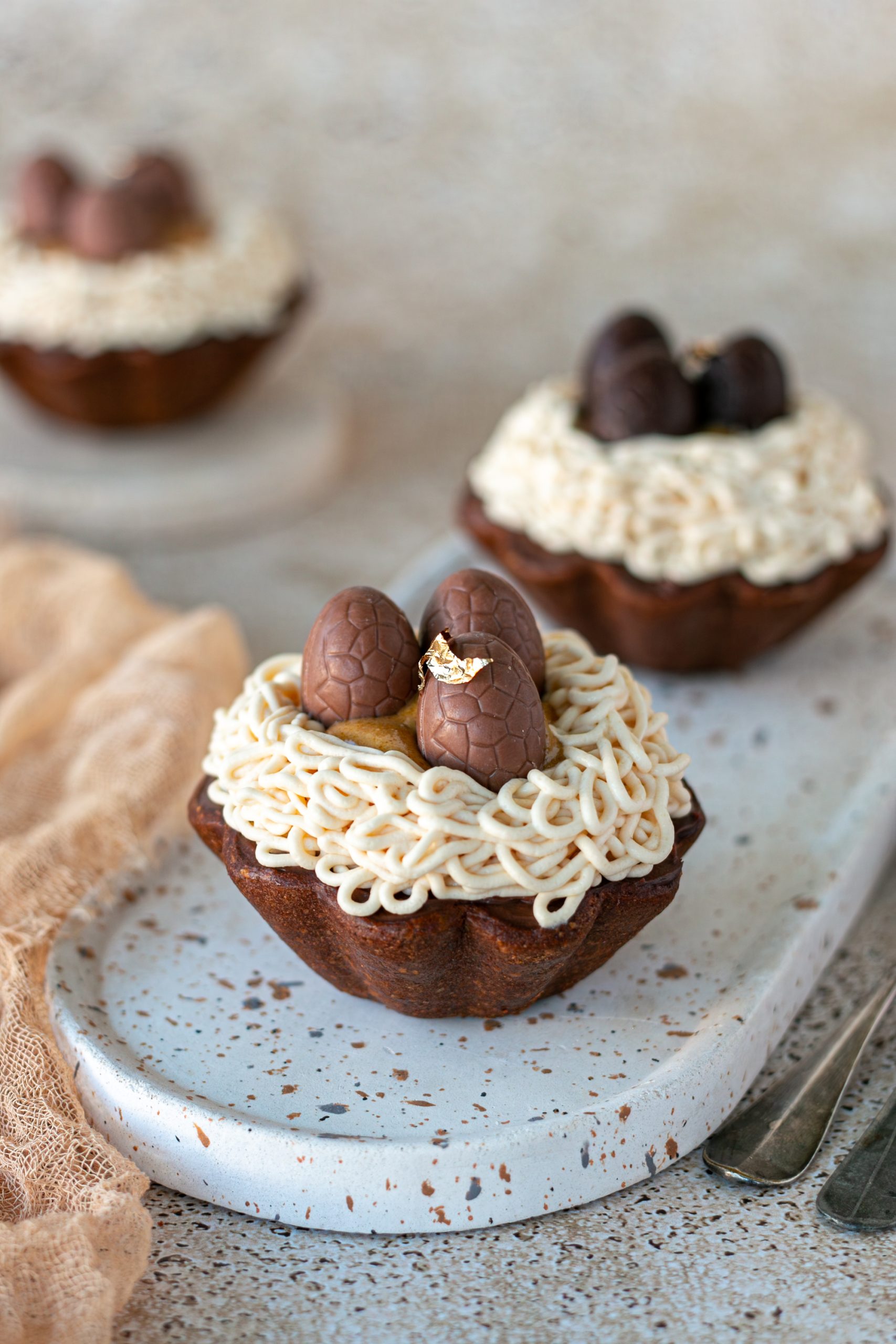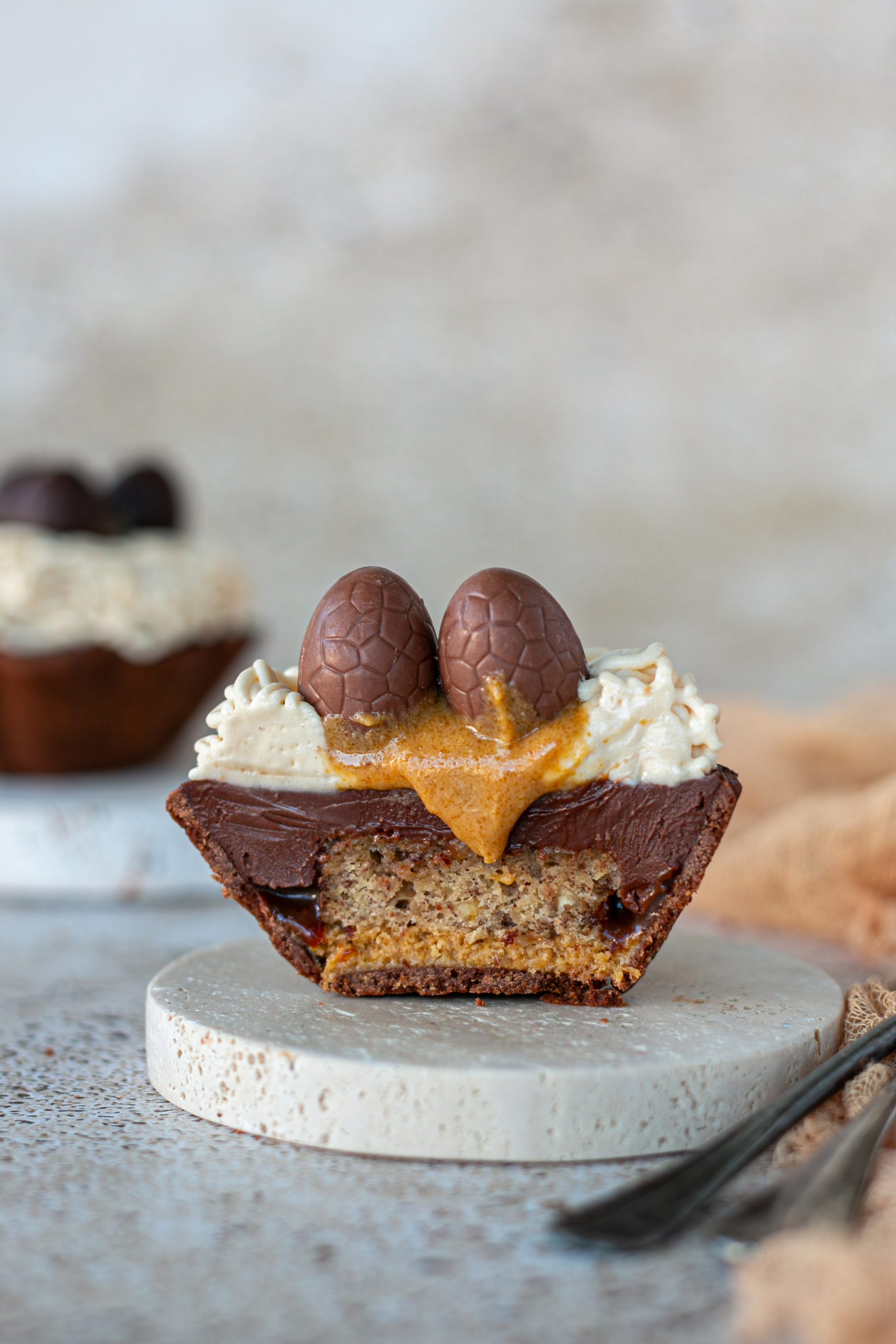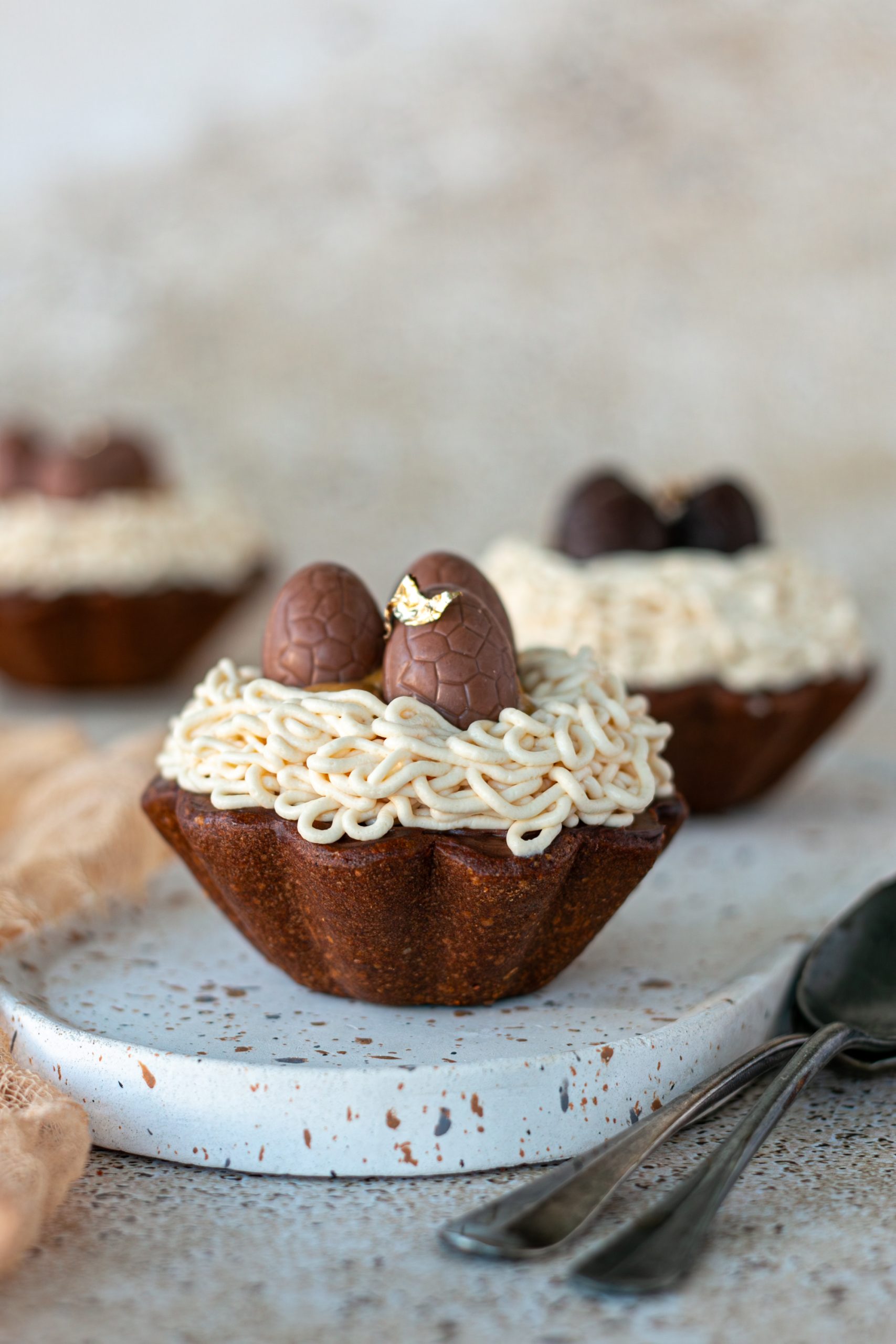



Easter is coming, and with it the craving for desserts that are both indulgent and refined! This year, I came up with tartlets that look like little Easter nests, topped with three little chocolate eggs. They’re made up of a cocoa pâte sablée, a praline crunchy layer made with kadaif, a soft peanut sponge, a smooth caramel, a dark chocolate crémeux, a peanut whipped ganache and a peanut praline… suffice to say that every bite is a real concentrate of indulgence!
Why use kadaif for the crunchy layer?
For these tartlets, I replaced my usual crunchy layer made with crêpes dentelle with kadaif. If you don’t know it yet, kadaif is that ultra-thin pastry used in Middle Eastern pastry-making, which creates an irresistible crunch. The texture is incredible: light, crisp, and it absorbs the praline perfectly without going soft.
Ever since Nour Kandler introduced me to kadaif, I don’t want to go back to crêpes dentelle! It’s easy to find in Middle Eastern grocery shops or online, but personally I simply found some at Carrefour (in the chilled world-foods section). Of course, nothing stops you from staying loyal to crêpes dentelle if you prefer, but I really recommend trying kadaif at least once.
How do you organise yourself to make these tartlets?
This dessert can be made in several stages, which is ideal for amateurs or for those who want to avoid stress on the day itself.
- Some elements can be prepared well in advance: the caramel keeps for up to 2-3 weeks and the praline for several months, which saves a huge amount of time.
- Even the tart shells can be made in advance. That’s exactly what I did, in fact; they had been baked and frozen for several weeks. And if you’re wondering whether they’re still just as crisp after thawing, the answer is yes (tested and approved many times).
- The whipped ganache, on the other hand, needs resting time in the fridge and must therefore be prepared the day before.
- The dark chocolate crémeux can be made the day before or a few hours before assembly. It will firm up and become more compact, but you just need to loosen it with a spatula before using it.
- On the day, all that’s left is to make the sponge and the crunchy layer, and to assemble everything.
By proceeding this way, you move forward gradually, without rushing, and you end up with a perfectly controlled and indulgent final dessert.
Which chocolate should you choose for these tartlets?
For this recipe, I used Valrhona’s Caraïbe 66% dark chocolate. It’s a couverture chocolate with hints of roasted nuts, which makes it perfect to pair with peanut and praline. Gently roasted or made into pralines, nuts enhance the natural flavours of the chocolate, for a result that is both indulgent and harmonious.
For lovers of more intense chocolate, Valrhona’s Guanaja 70% is an ideal alternative. This chocolate blends cocoa beans from different terroirs, offering exceptional aromatic complexity, roasted notes and a pleasant bitterness. It brings a remarkable intensity to your creations, perfect for those who love powerful, well-contrasted desserts.
And to anticipate your questions: I strongly advise against milk chocolate here. The whole dessert would be far too sweet.
In short, as you’ll have gathered, these indulgent little Easter nests are a real treat! And if I haven’t managed to convince you, you may find what you’re looking for with the chocolate caramel tart, the all-chocolate layer cake and its Easter garden or the chocolate, caramel and peanut entremets tart, which actually inspired me to make these little Easter nests.

Ingredients & method
8 components · Full recipe
Cocoa shortcrust pastry (to make the day before)
Ingredients
- 155 g (5.5 oz) T55 flour
- 65 g (2.3 oz) icing sugar
- 20 g (0.7 oz) Pariani almond flour
- 15 g (0.5 oz) cocoa powder
- 1 g (0 oz) fleur de sel
- 100 g (3.5 oz) cold butter
- 50 g (1.8 oz) egg (1 egg)
Method
1
Turn the moulds upside down, dome side up, and very lightly butter their outer surface (or use a grease spray). Place a pastry disc on each upturned mould, then guide the pastry with your fingers so it conforms to the shape without being stretched.
2
Place the lined moulds in the fridge to firm the pastry again. This will set its shape and reduce the risk of shrinkage during baking.
3
In the stand mixer bowl, add all the dry ingredients (flour, cocoa powder, icing sugar, fleur de sel and almond flour).
4
Add the cold butter cut into small pieces (but pliable) and work into a sandy texture using the paddle attachment or with your fingertips. When the butter is fully incorporated, you get a cocoa-scented sandy mixture.
5
Add the whole egg beaten as an omelette and mix quickly. Do not overwork the dough. Bring it together to form a ball without kneading.
6
Wrap the pastry in cling film, shaping it into a flat rectangle. Refrigerate for at least one hour.
Peanut praliné (can be made in advance)
Ingredients
- 250 g (8.8 oz) unsalted peanuts
- 125 g (4.4 oz) sugar
- 1 pinch of fleur de sel
Method
1
Toast the peanuts in the oven for about 15 minutes at 150°C / 300°F. Leave to cool.
2
In a heavy-bottomed saucepan, make a dry caramel with the sugar. You need to achieve a dark golden colour. Don’t take your eyes off it – it can go quickly.
3
Pour the caramel onto a baking tray lined with baking paper or a silicone mat. Leave to cool.
4
Once everything (caramel and peanuts) is completely cold, break up the caramel sheet and place it in a food processor with the peanuts and fleur de sel.
5
Blend, taking regular breaks (to prevent the paste from overheating and to scrape down the sides), until you reach a praliné consistency. The longer you blend, the more liquid it will become.
Peanut whipped ganache (to make the day before)
Ingredients
- 125 g (4.4 oz) milk
- 80 g (2.8 oz) peanut paste
- 215 g (7.6 oz) full-fat whipping cream
- 50 g (1.8 oz) Valrhona Ivoire 33% white chocolate
- 3 g (0.1 oz) powdered gelatine
- 18 g (0.6 oz) water (to rehydrate the gelatine)
Method
1
Rehydrate the gelatine in the water.
2
Melt the white chocolate in the microwave.
3
Heat the milk, then off the heat, add the rehydrated gelatine.
4
Pour one third of the milk over the white chocolate and mix to create an emulsion. Then add the second third, then the third, to obtain a smooth and homogeneous mixture.
Baking the tart shells
Ingredients
- 1 egg yolk
- 2 g (0.1 oz) full-fat cream
Method
1
Bake for 15 to 20 minutes first. Leave to cool then carefully unmould the tart shells by lifting them. They should come away without difficulty if the baking and buttering were done correctly.
2
Once cooled (they will be less fragile), brush them with a mixture of egg yolk and cream to seal them (and make the pastry shine).
3
Return to the oven for 10 to 15 minutes. Leave to cool again.
Dark chocolate cremeux
Ingredients
- 100 g (3.5 oz) whole milk
- 200 g (7.1 oz) full-fat whipping cream
- 36 g (1.3 oz) egg yolks
- 25 g (0.9 oz) sugar
- 155 g (5.5 oz) Valrhona Caraïbe 66% dark chocolate
Method
1
Place the chocolate in a bowl and melt it slightly in the microwave. Set aside.
2
In another bowl, whisk the egg yolks with the sugar.
3
In a saucepan, heat the cream and milk and bring to a gentle simmer.
4
Slowly pour the hot cream over the egg yolks and sugar, then return everything to the saucepan.
5
Heat to 82°C / 180°F, stirring continuously. The cream will thicken. As with a crème anglaise, be careful not to exceed this temperature. If you don’t have a thermometer, here is chef Michalak’s tip: whisk the mixture quickly, then stop. If the ‘whirlpool’ stops immediately, the cream is at the right temperature.
6
Pour the cream over the melted chocolate in 3 additions (using a sieve) and create an emulsion. Blend with an immersion blender to smooth the cremeux without incorporating air.
Peanut soft cake
Ingredients
- 50 g (1.8 oz) peanut powder (finely blended roasted peanuts)
- 30 g (1.1 oz) brown sugar
- 50 g (1.8 oz) egg
- 11 g (0.4 oz) icing sugar
- 11 g (0.4 oz) full-fat cream
- 47 g (1.7 oz) butter
- 25 g (0.9 oz) flour
- 2.8 g (0.1 oz) baking powder
- 50 g (1.8 oz) egg white
- 8.3 g (0.3 oz) brown sugar
Method
1
Finely blend previously toasted unsalted peanuts to obtain a powder.
2
In a bowl, mix together the peanut powder, brown sugar, egg, icing sugar and cream.
3
Melt the butter in a saucepan until it turns a hazelnut colour (keep stirring continuously). The butter is ready when it has a delicious nutty aroma and stops ‘singing’. Add it still hot to the rest of the ingredients while continuing to mix.
4
Add the sifted flour and baking powder.
5
Whip the 50 g (1.8 oz) egg whites to stiff peaks, stiffening them with the 8.3 g (0.3 oz) of brown sugar, then fold them delicately into the first mixture using a spatula.
6
Pour the batter onto one half of a baking tray lined with baking paper and smooth with an offset spatula.
Praliné crunch (Nour Kandler’s recipe)
Ingredients
- 50 g (1.8 oz) kadaif
- 20 g (0.7 oz) butter
- 130 g (4.6 oz) peanut praliné
Method
1
Preheat the oven to 160–170°C / 340°F, preferably with fan-assisted heat.
2
Melt the butter in the microwave.
3
Shred the kadaif by hand to separate the strands and avoid clumps. Spread it on a piece of baking paper placed on a baking tray, without compacting it.
4
Pour the melted butter over it, then gently mix to coat everything.
5
Bake at mid-height for about 15 to 20 minutes. Stir gently halfway through for even browning. Watch closely until it turns a beautiful golden colour.
6
Remove from the oven and leave to cool completely on the tray to preserve all the crunch.
Assembly
Ingredients
- None
Method
1
Pour a little praliné crunch into the tart shells and spread evenly with the back of a small spoon.
2
Place a peanut biscuit disc and soak it with a sugar syrup using a pastry brush.
3
Pipe a ring of caramel around it (mine wasn’t homemade but I obviously recommend making your own if you have time. You’ll find the recipe here).
4
Soften the chocolate cremeux with a spatula then place it in a piping bag without a nozzle. Pipe it to the top and smooth with a small offset spatula.
5
Whip the peanut ganache with an electric mixer and place it in a piping bag fitted with a vermicelli nozzle.
6
Pipe the ganache over the chocolate cremeux, creating a small nest in the centre. Add a little peanut praliné in the nest, then place 3 chocolate eggs.
Gallery