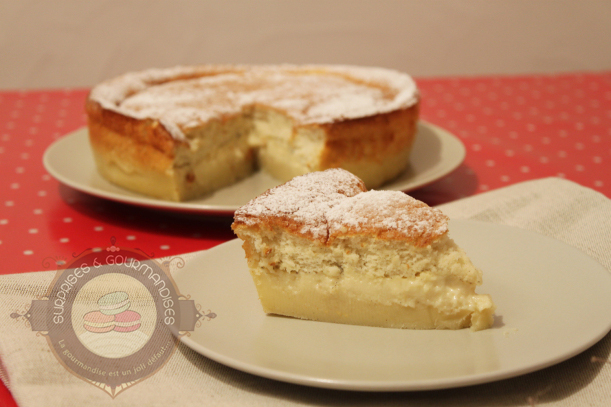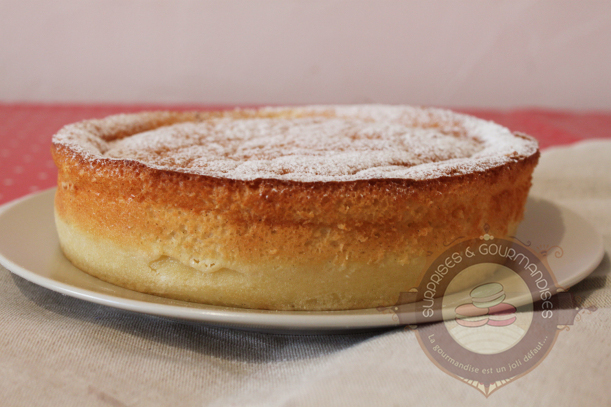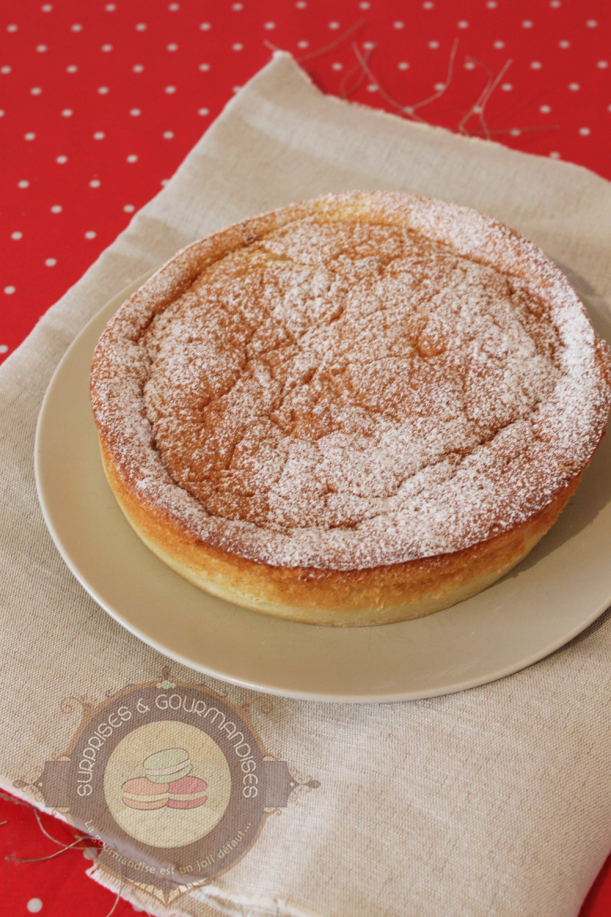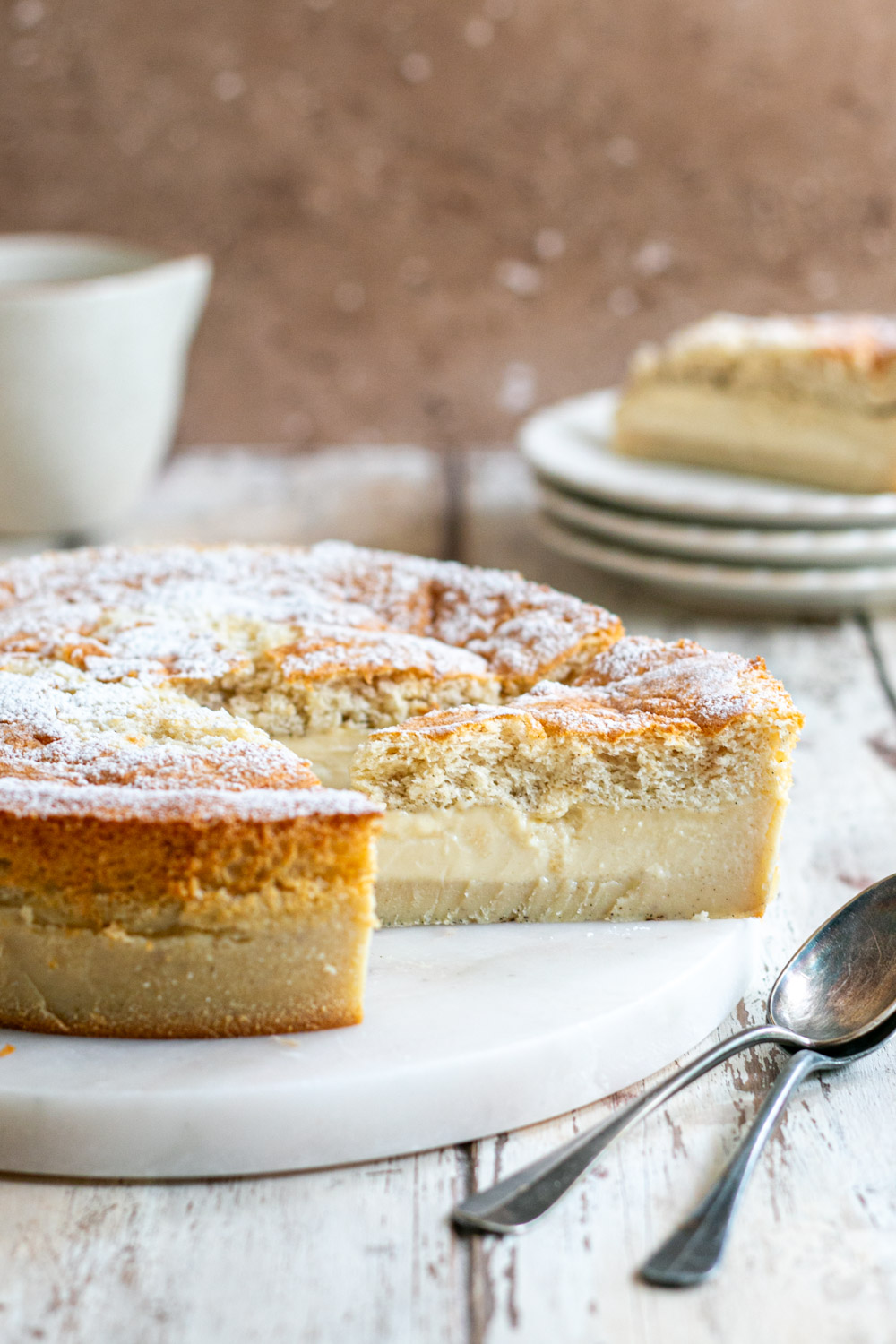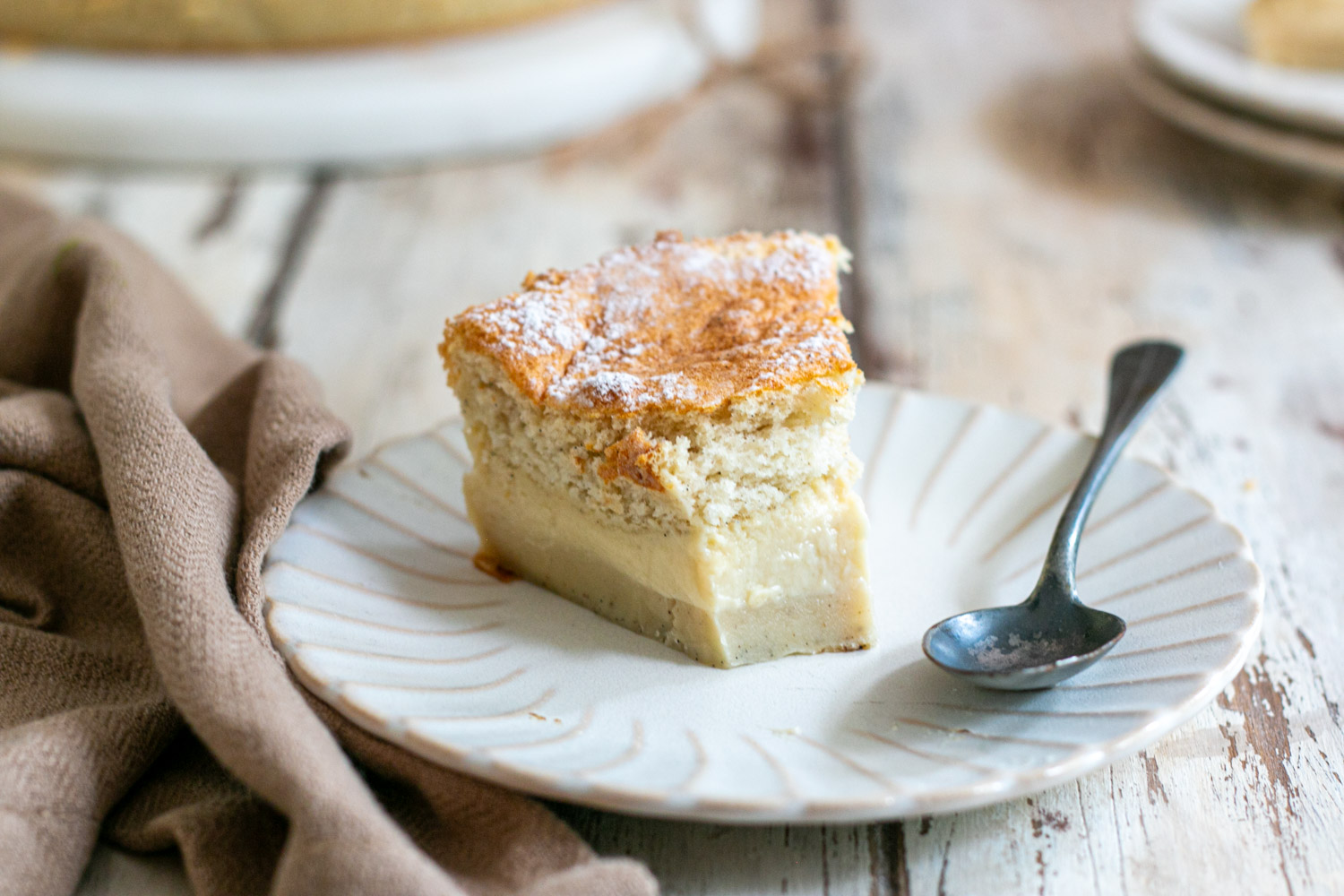



I too have given in to the new magic cake craze that can be found just about everywhere in the food blogosphere. I went for the classic vanilla version. Little books have recently come out on the subject, but the magic cake has been around for a while. It was Carine from the blog Chic, chic, chocolat who posted the first recipes, starting with a chocolate magic cake, then a vanilla one, but you can now find new variations of this cake. In short, as you’ll have gathered, you can adapt the concept endlessly to suit your tastes!
Why is this cake magic?
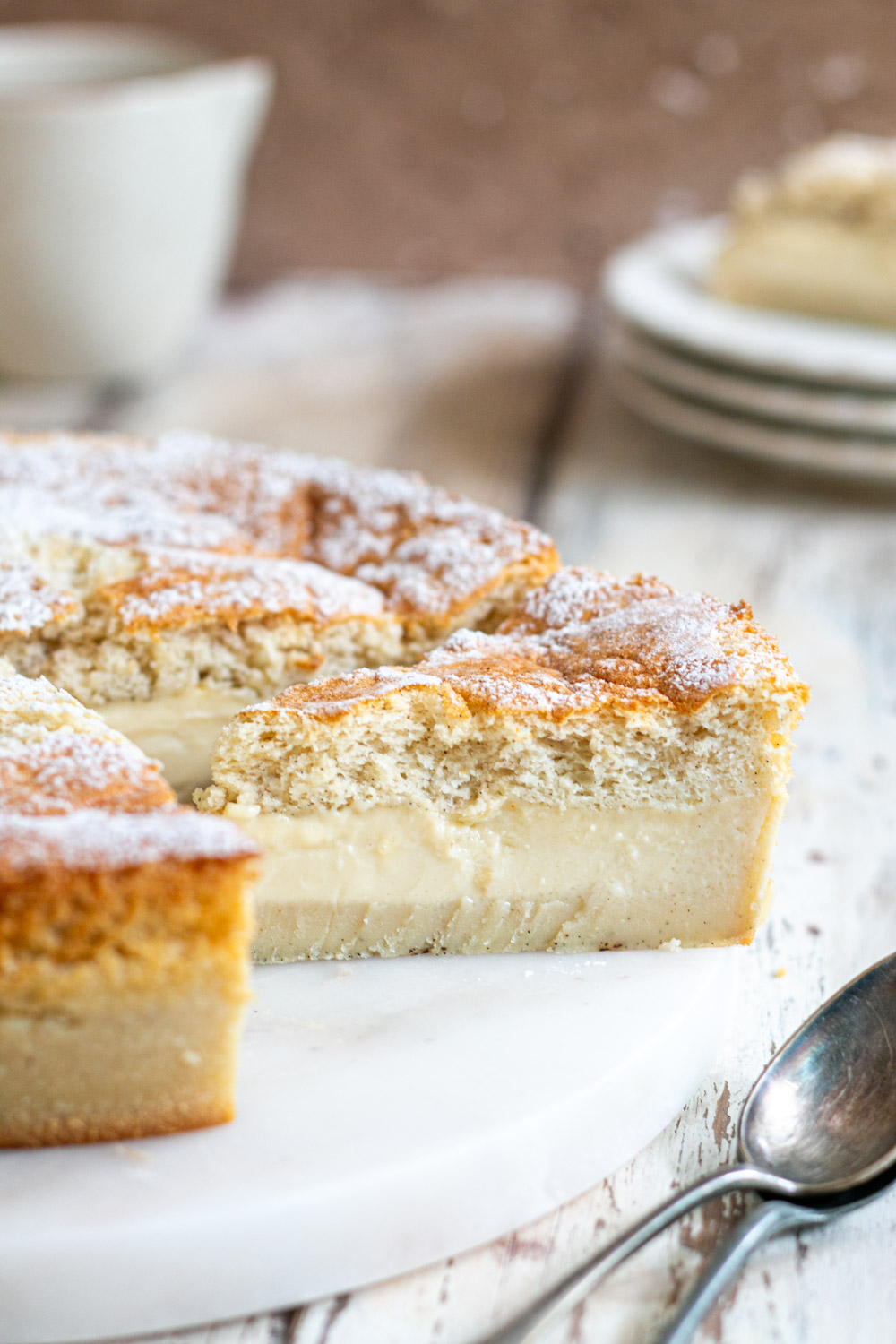
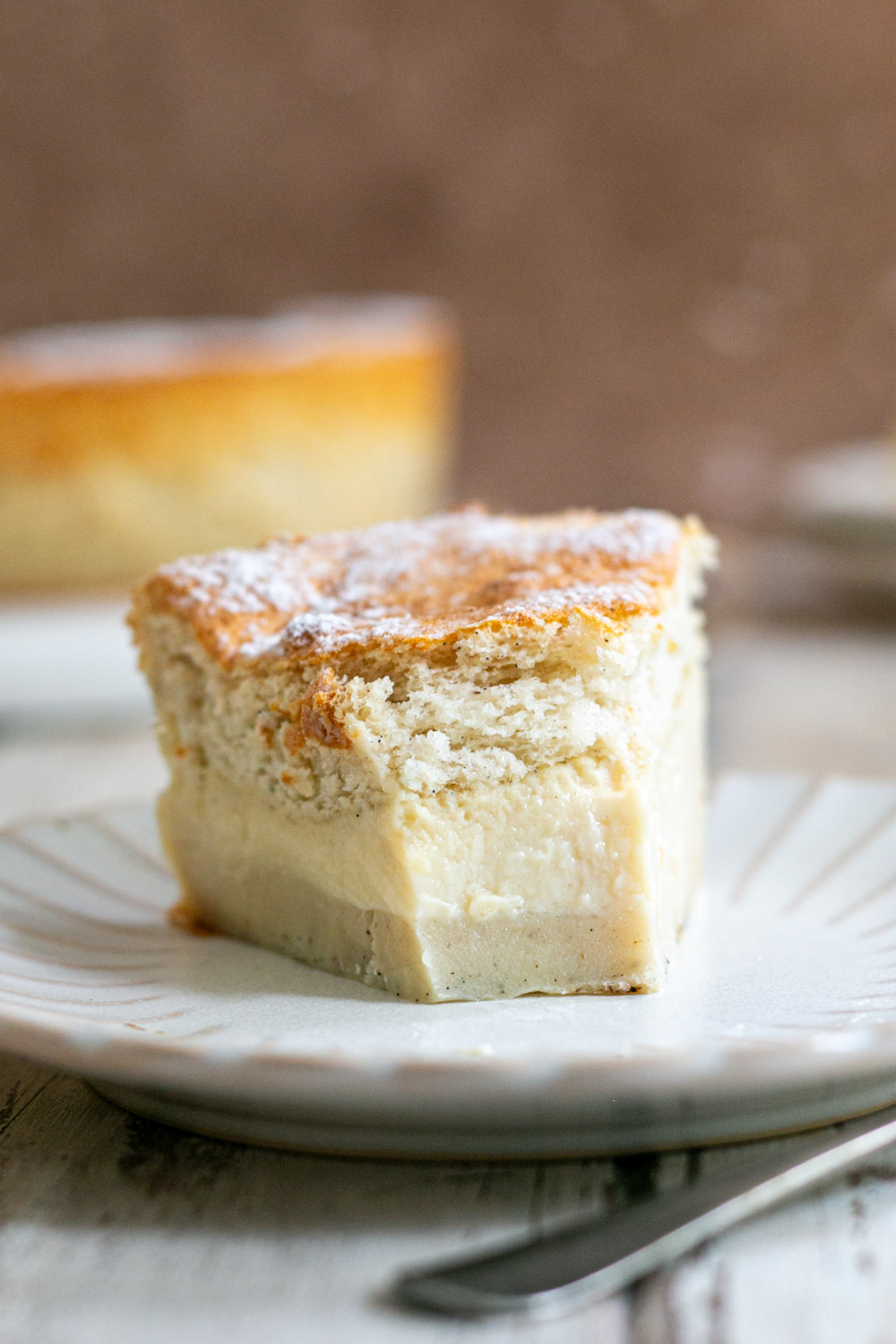
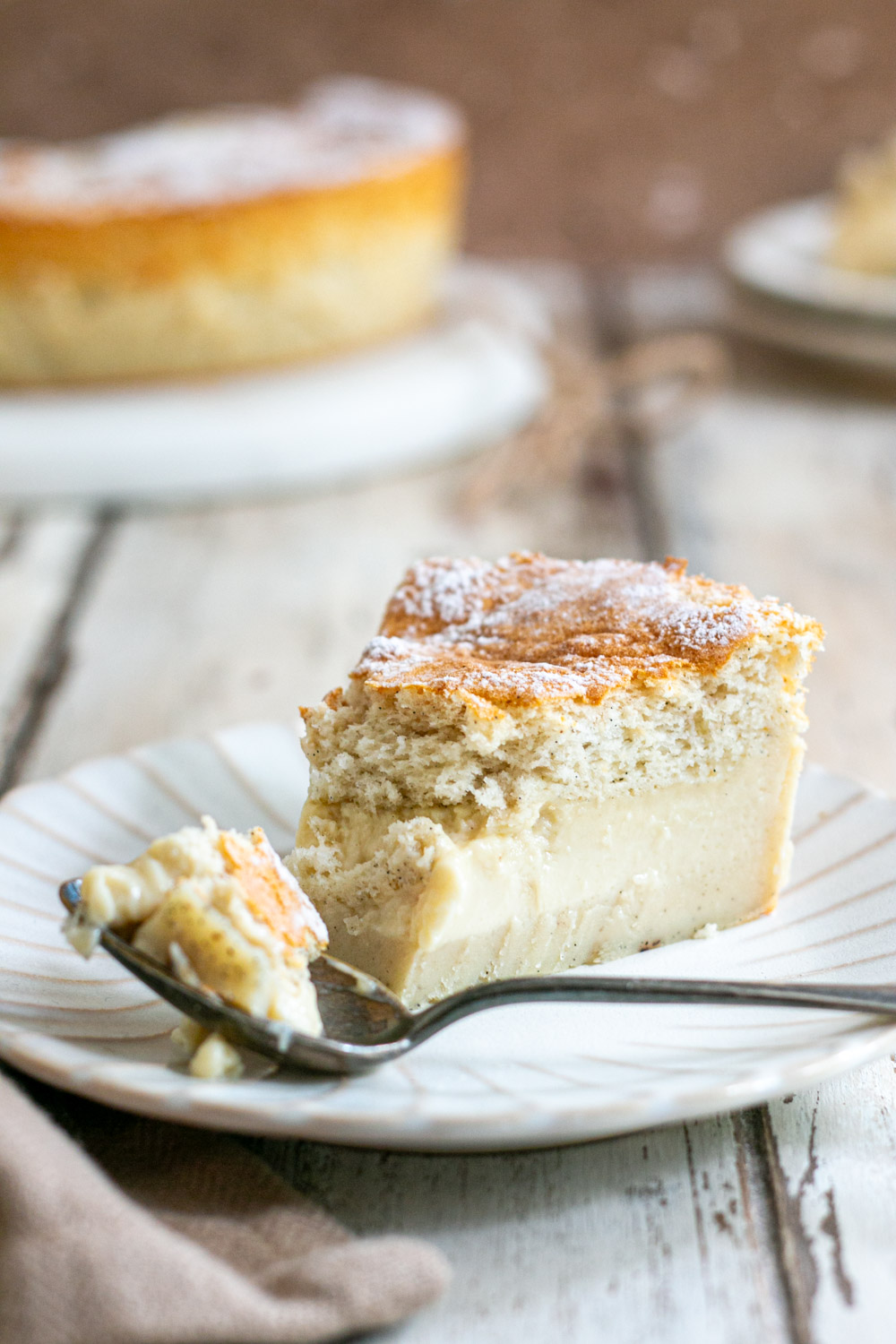
Its ingredients are nothing sensational, though: eggs, sugar, flour, butter and milk. So far, nothing special, because it’s the baking that will act as the magic wand. Indeed, once in the oven, the cake divides into three layers with different flavours and textures: a flan base, a light cream in the centre and a very airy génoise sponge on top. And here are a few explanations for the more sceptical among you. The egg yolks whisked with the sugar, butter, flour and milk create the flan base and the light cream. This is thanks to slow baking (150°) with natural convection, which cooks the bottom of the cake like a flan without cooking the central cream. Finally, the génoise layer is formed by the stiffly beaten egg whites. These don’t blend in with the milk, which allows them to float on top of this delicious cake.
How do you make this magic cake a success?
The key to success lies in the whites. You need to start whisking them at low speed, then increase it gradually. Once the whites are well whipped, add them straight away to the batter. But you mustn’t knock them back. There will be lots of lumps and the whites will stay on the surface, but that’s normal.
As for the choice of mould, round or square, silicone, pyrex (buttered beforehand or with a sheet of baking paper placed at the bottom), it doesn’t matter, but it mustn’t be too wide, otherwise the baking won’t be the same and in the end the layers won’t be distinct enough. I used a 20 cm diameter silicone mould (you could go up to 22 cm) in which I placed baking paper at the bottom (I also advise you to put some on the sides, for a smooth unmoulding.
For baking, you need to use the conventional (non-fan) setting. If that’s not possible, lower the oven temperature by 10°C. The cake rises during baking, sometimes cracks, then sinks back as it cools. That’s completely normal!
Unmoulding and cutting are done when the cake is completely cold. If it’s made the day before, even better. Unmoulding is done by turning the cake out a first time onto a tray and then, in a second step, onto the serving plate. The génoise layer ends up on top.
Ingredients & preparation
1 component · Full recipe
Magic Cake
Ingredients
- 4 eggs (at room temperature)
- 500 ml (16.9 fl oz) whole milk
- 150 g (5.3 oz) sugar
- 125 g (4.4 oz) butter
- 115 g (4.1 oz) plain flour
- 1 vanilla pod
- 1 teaspoon vanilla sugar
- 1 pinch of salt
- 1 tablespoon orange blossom water (or plain water)
Preparation
1
Heat the milk with the scraped vanilla pod and leave to infuse for about twenty minutes, covered. The milk should be lukewarm by the end.
2
Melt the butter in the microwave and leave it to cool to lukewarm.
3
Separate the yolks from the whites.
4
Using an electric mixer, beat the egg yolks, sugar and orange blossom water together for a few minutes.
5
Add the lukewarm melted butter and continue beating.
6
Add the sifted flour and salt and mix quickly, still using the electric mixer.
7
Gradually add the lukewarm milk (with the pod removed) and beat until everything is well combined.
8
Wash and dry the whisk attachments. Whip the egg whites to stiff peaks, then fold them gently into the batter in several additions using a spatula. There should still be lumps — this is what will give you the sponge layer during baking.
9
Pour the batter into a 20–22 cm (8.7 in) round tin lined with baking paper — this will make it easier to unmould. The batter is very liquid, which is perfectly normal. Use the back of a spoon or a spatula to smooth the surface.
10
Bake in a preheated oven at 150°C / 300°F (conventional heat, not fan) for about 50 minutes. The centre should still have a very slight wobble when it comes out of the oven.
11
Leave the cake to cool completely, then refrigerate for 2 hours before unmoulding. You can make it the day before and leave it to chill overnight.
12
Just before serving, dust with icing sugar.

Gallery