

On this Mother’s Day, I’m offering you a recipe that contains no red berries, an entremets that’s neither pink nor red and that isn’t heart-shaped, no… To be honest, I didn’t bake for this particular occasion, so I’m offering you the last recipe I made before lockdown, just a few days before. At the time, I didn’t know it would be the last entremets I’d make for quite a while (nor that it would be the last evening with friends).
Once again, and I’m somewhat sorry about it, baking has been pushed into the background. Yet, a few days before lockdown, I was at Metro restocking my raw materials, I was fired up, with lots of ideas and things to try. But there you go, I fell ill with Covid, followed by a collapse of my lower back pain (physiotherapy and sport stopped because of lockdown, a terrible combo). Since then, I’ve been suffering horribly with my back, to the point of no longer being able to walk by the end of the day. So I no longer feel any pleasure at the thought of going into the kitchen and standing up to make a cake. It’s so sad… but it will surely come back. Once I’ve found an acceptable level of pain again…
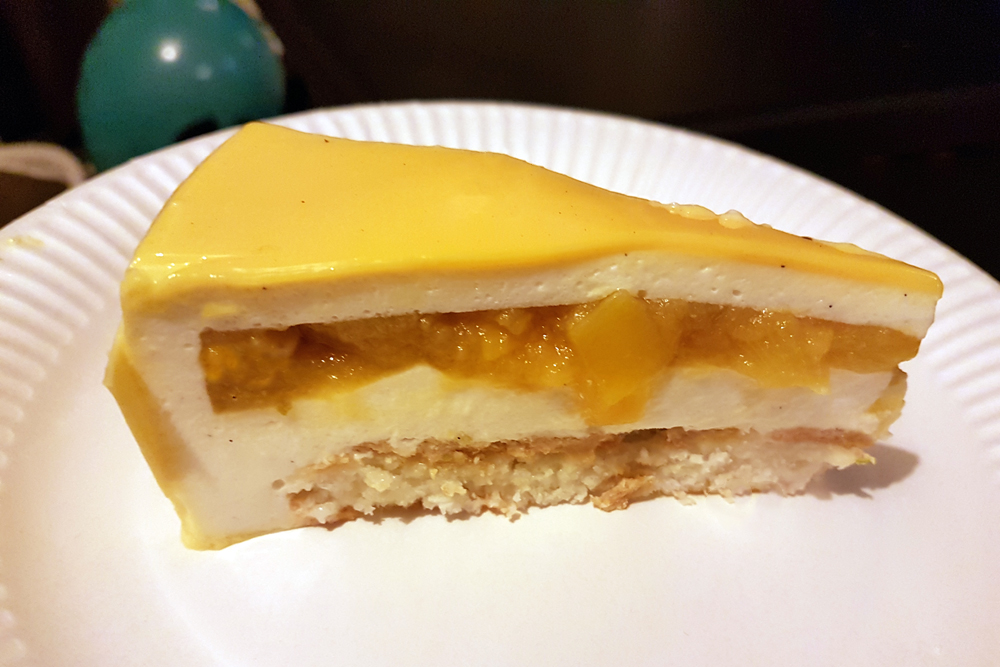
In the meantime, I’m digging through my little archives for recipes not yet published on the blog. Today, it’s an exotic recipe based on mango, pineapple and coconut. A festival of freshness that delighted my friends’ taste buds. For the mango pineapple compote, I borrowed the recipe from Auriane of the blog Sucre d’orge et pain d’épices. As for the coconut soft sponge, it’s Claire Heitzler I have to thank for this recipe. If long recipes (but well explained :P) don’t scare you, go for it, you won’t regret it!
Ingredients & method
7 components · Full recipe
Mirror Glaze (can be made ahead)
Ingredients
- 150 g (5.3 oz) sugar
- 150 g (5.3 oz) glucose syrup
- 75 g (2.6 oz) water
- 150 g (5.3 oz) white chocolate
- 10 g (0.4 oz) gelatine
- 100 g (3.5 oz) full-fat liquid cream
- yellow food colouring
Method
1
Ideally, make the glaze the day before and reheat it in the microwave when ready to use.
2
Soak the gelatine in very cold water for 10 minutes.
3
Heat the water, sugar and glucose syrup to 103°C / 217°F.
4
In a bowl, combine the liquid cream then add the squeezed-out gelatine.
5
Pour the contents of the saucepan into the bowl. Mix well, then add the white chocolate cut into small pieces. Mix again.
6
Add the yellow food colouring and blend with a stick blender until smooth — be careful not to incorporate air, which would create unsightly bubbles. Pass the glaze through a fine sieve and leave to cool.
Mango Pineapple Compote (to be made the day before)
Ingredients
- 600 g (21.2 oz) pineapple (400 g (14.1 oz) for the purée + 200 g (7.1 oz) for the brunoise)
- 80 g (2.8 oz) mango purée
- 130 g (4.6 oz) water
- 25 g (0.9 oz) sugar
- 13 g (0.5 oz) cornstarch
- 3 g (0.1 oz) NH pectin
- 25 g (0.9 oz) sugar
- 25 g (0.9 oz) water
- zest of ½ lime
Method
1
Cut both ends off the pineapple with a serrated knife. Slice off the skin. Remove the ‘eyes’ by cutting diagonally into the flesh to take out each row. Cut the pineapple into quarters and remove the tough core from the centre.
2
Cut the pineapple into a brunoise (small dice).
3
In a saucepan, place 400 g (14.1 oz) of the pineapple brunoise and add the mango purée, 25 g (0.9 oz) of sugar and the water. Cook over a low heat for about 1 hour, stirring regularly.
4
Blend the compote with a stick blender. Set aside.
5
In a separate saucepan, mix together the cornstarch, 25 g (0.9 oz) of sugar and the NH pectin, then dissolve in the water.
6
Add the previously prepared pineapple compote and bring to the boil. Cook for 1–2 minutes over a medium heat.
7
Off the heat, stir in the remaining 200 g (7.1 oz) of pineapple brunoise and the lime zest. Pour into your insert mould (18 cm (7.1 in) diameter), leave to cool, then transfer to the freezer overnight.
Coconut Sponge (recipe by Claire Heitzler)
Ingredients
- 110 g (3.9 oz) desiccated coconut
- 50 g (1.8 oz) icing sugar
- 60 g (2.1 oz) egg whites (about 2 whites)
- 10 g (0.4 oz) liquid cream
- 90 g (3.2 oz) egg whites (about 3 whites)
- 50 g (1.8 oz) sugar
Method
1
Preheat the oven to 160°C / 325°F.
2
Blend together the desiccated coconut and icing sugar to refine the powders.
3
Add the 60 g (2.1 oz) of egg whites and the liquid cream. Mix together.
4
Separately, whisk the remaining 90 g (3.2 oz) of egg whites, gradually adding the sugar and continuing to whisk until the meringue holds a firm peak when you lift the whisk.
5
Fold the first mixture into the meringue gently with a spatula.
6
Pour the batter into a 20 cm (7.9 in) diameter cake ring set on a sheet of baking paper. Bake for approximately 20 minutes. Leave to cool inside the ring, then transfer to a wire rack until assembly.
Coconut Crunch
Ingredients
- 30 g (1.1 oz) liquid cream
- 80 g (2.8 oz) white chocolate
- 35 g (1.2 oz) desiccated coconut
- 45 g (1.6 oz) feuilletine (gavottes)
Method
1
Melt the white chocolate in the microwave in a large bowl.
2
In a small saucepan, heat the cream until just boiling.
3
Pour the cream over the white chocolate and mix with a spatula to make a ganache.
4
Crumble the feuilletine and stir it into the ganache.
5
Finally, add the desiccated coconut and fold in one last time. Spread the coconut crunch over the coconut sponge using a small offset spatula — this is easier to do while the ring is still in place. Remove the ring and refrigerate until assembly.
Coconut Mousse
Ingredients
- 250 g (8.8 oz) coconut milk
- 30 g (1.1 oz) caster sugar
- 250 g (8.8 oz) full-fat whipping cream
- 8 g (0.3 oz) powdered gelatine
- 48 g (1.7 oz) water (to rehydrate the gelatine)
Method
1
Rehydrate the gelatine in the water.
2
In a small saucepan, heat the coconut milk with the sugar.
3
Off the heat, add the rehydrated gelatine. Leave the sweetened coconut milk to cool in a bowl.
4
Whip the cream until light and foamy — do not overwhip. Once the coconut milk has cooled to 45°C / 113°F, gently fold in the whipped cream. Set aside.
Assembly
Ingredients
- None
Method
1
Cover the base of a 22 cm (8.7 in) diameter ring mould with cling film.
2
Line the inside of the ring with an acetate strip, then pour in about three-quarters of the coconut mousse, spreading it up the sides with a spatula for a clean finish. If the mousse seems too fluid, chill it briefly in the freezer or fridge first to prevent the insert sinking to the bottom. Place the frozen mango pineapple disc on top and press lightly to push the mousse up the sides. Pour over the remaining coconut mousse, then finish the assembly by pressing in the coconut sponge/coconut crunch base (crunch side facing the mousse). Press gently, smooth the top with an offset spatula, wrap in cling film and freeze overnight.
Decoration
Ingredients
- None
Method
1
Reheat the mirror glaze until it reaches approximately 30°C / 86°F.
2
Remove the entremet from the freezer and unmould. Remove the acetate strip. Run a warm hand along the top edge to smooth and soften the rim.
3
Place the frozen entremet on a wire rack set over a plate or tray to catch the excess glaze.
4
Pour the mirror glaze gently over the entremet to coat it completely. Tap the rack lightly.
5
Lift the entremet off the rack and place on a serving dish.
6
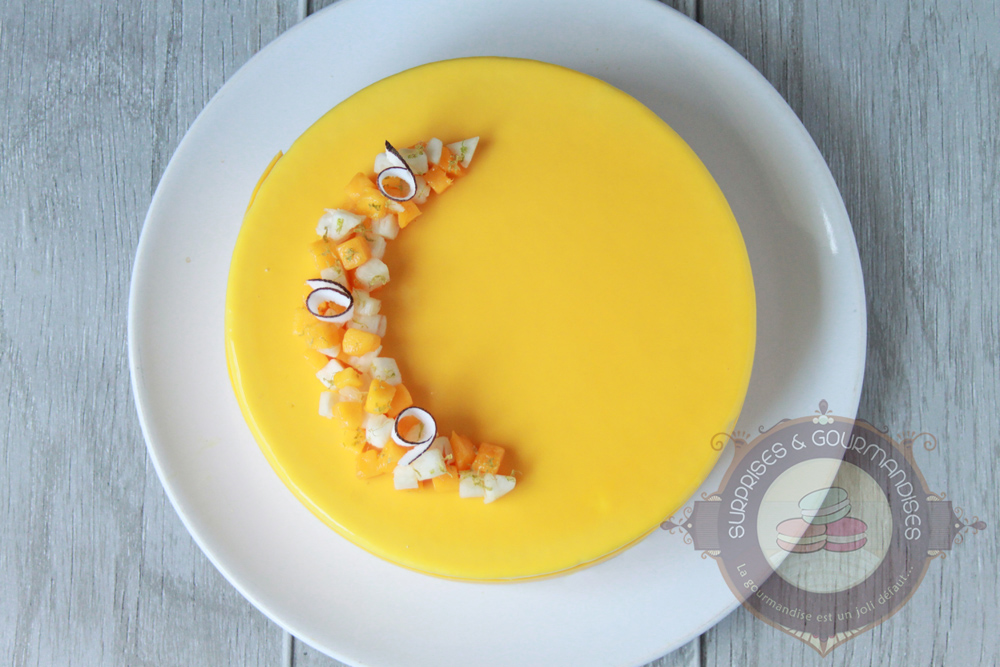
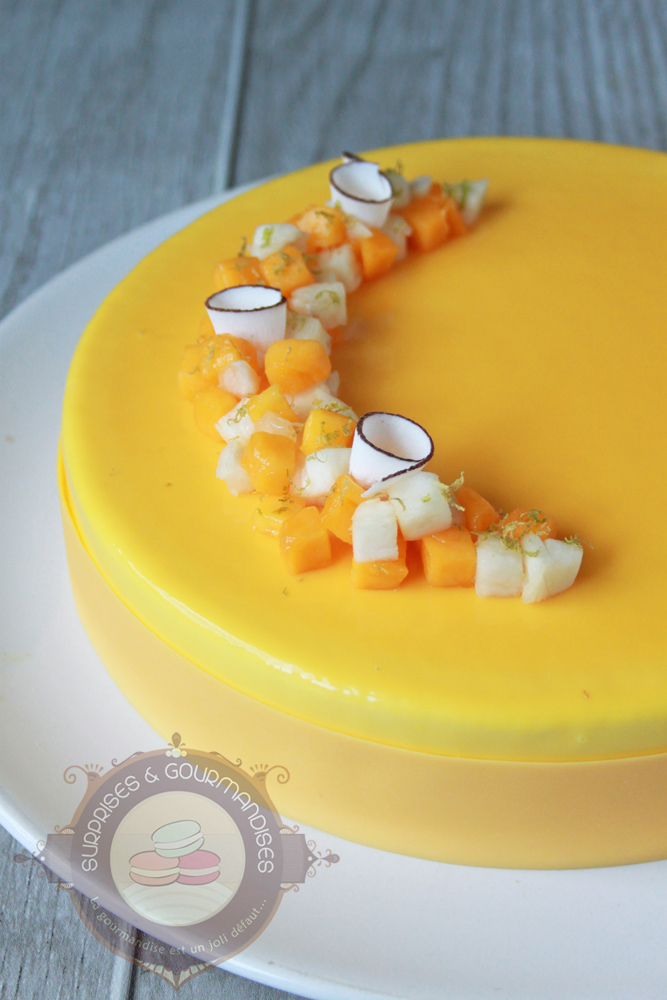
Leave to thaw in the fridge — allow at least 7–8 hours minimum (longer when using fresh fruit). For the decoration, I made a white chocolate band (coloured with fat-soluble food dye), then arranged a mix of mango brunoise, pineapple (I used a sugarloaf variety, hence the slightly pale colour), lime zest and a few coconut shavings on top.
Gallery