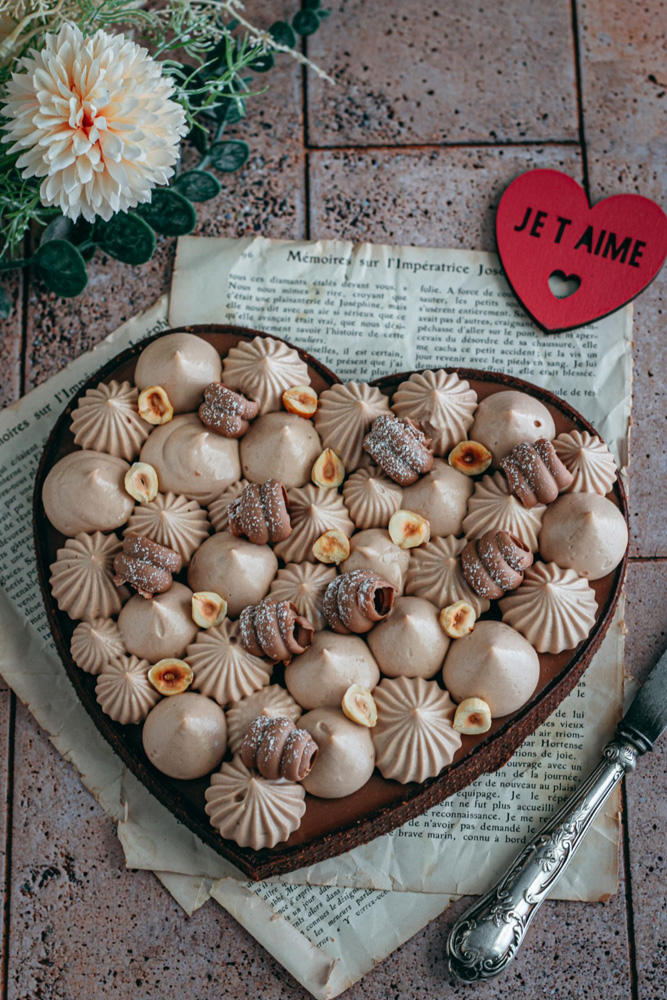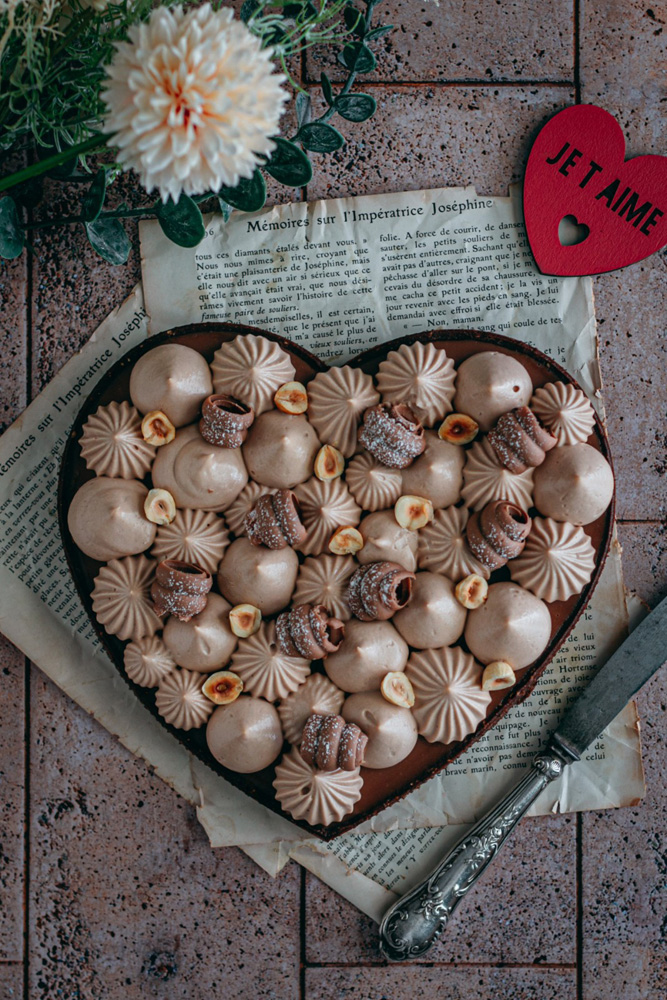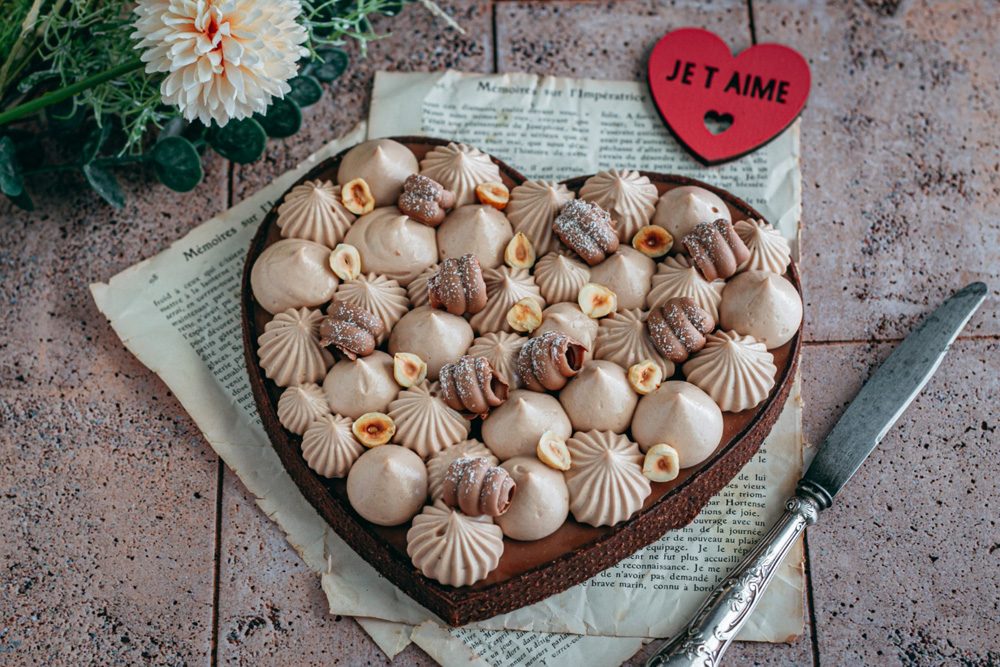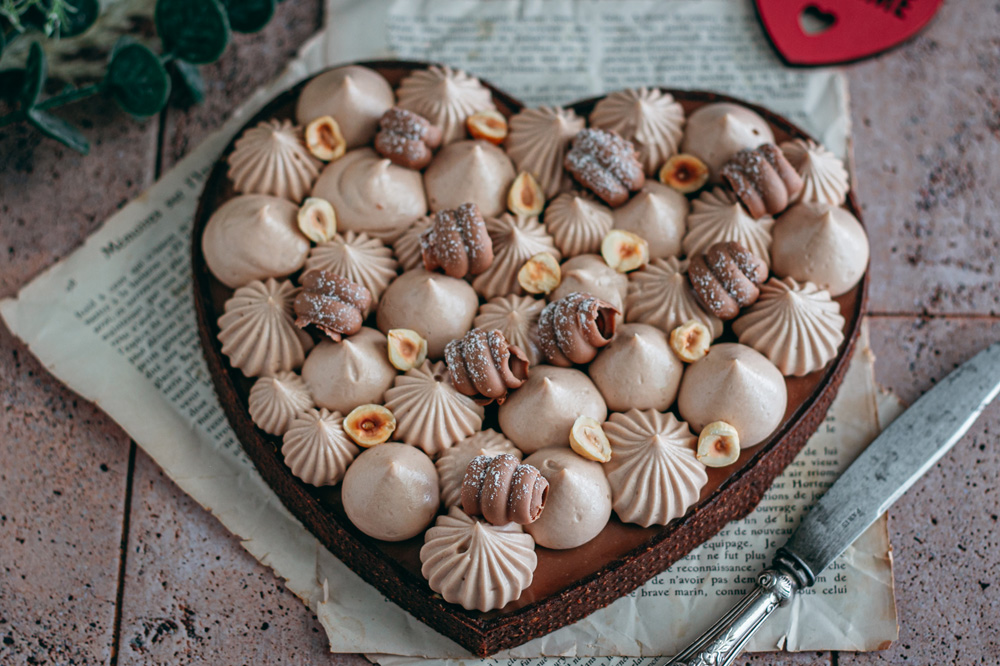



After the raspberry and poppy layer cake full of freshness, here’s an ultra-indulgent recipe for Mother’s Day: the gianduja tart, heart-shaped for the occasion of course (you can make it in another shape) .
A few days ago, I asked you on Instagram to choose the flavour of my next special “Mother’s Day” dessert, and gianduja won, ahead of Dulcey, chocolate and caramel.
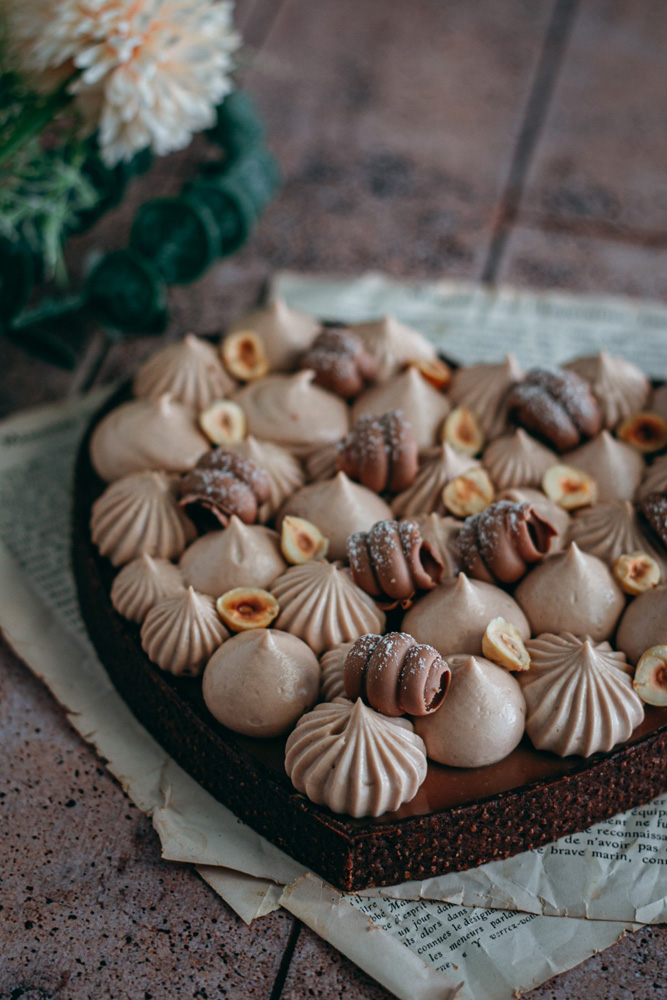
This gianduja tart is therefore made up of a cocoa pâte sucrée, a hazelnut cream, a gianduja crémeux and a gianduja whipped ganache. If you’re a gianduja lover (or a hazelnut lover more generally), this dessert will undoubtedly please you.
What is gianduja?
Originating from Italy, and more precisely from Piedmont (in the north-west of Italy), gianduja (or gianduia) is a pure praline made essentially of hazelnuts. Unlike praline, here the sugar isn’t caramelised. The resulting paste is ground much more finely, the quantity of fat is higher and there’s also more chocolate.
If you don’t have gianduja, you can very well make it yourself; it’s really very simple (it’s a mixture of icing sugar, hazelnuts and milk chocolate). You’ll easily find the recipe online. Having already made it myself, I must admit that Valrhona’s is incomparable. The hazelnut flavour is powerful, it’s just insane!
How do you get your tart base right?
I can already hear you saying “but my pastry always collapses during baking” or “I never manage to make a nice tart base”. In fact, the secret of a successful tart base is resting. But let’s start at the beginning: to prevent the pastry from collapsing during baking, you need to take a few precautions when making the dough. First, use T55 flour; it helps avoid a dough that’s too elastic. Also, you mustn’t overwork the dough when incorporating the ingredients. The more you work the dough, the more you work the gluten (that’s precisely what makes the dough elastic). So, as soon as all the ingredients have come together, stop.

Ingredients & Method
5 components · Full recipe
Gianduja whipped ganache (make the day before)
Ingredients
- 60 g (2.1 oz) full-fat whipping cream
- 6 g (0.2 oz) glucose
- 102 g (3.6 oz) milk gianduja
- 1.2 g (0 oz) gelatine (a tiny bit more than 1/2 sheet)
- 175 g (6.2 oz) very cold full-fat whipping cream
Method
1
Soak the gelatine sheet in cold water to soften.
2
In a bowl, cut the gianduja into small pieces and melt it in the microwave.
3
In a saucepan, heat the 50 g (1.8 oz) of liquid cream with the glucose. Then, off the heat, add the squeezed-out gelatin.
4
As soon as the cream simmers, pour one-third over the gianduja and stir to create an emulsion. Then add a second third, then a third, until the mixture is perfectly smooth and homogeneous.
5
Add the remaining cold cream and stir gently.
6
Cover with plastic wrap directly on the surface and refrigerate for several hours (ideally overnight).
Cocoa sweet pastry (start 2 days ahead or the day before)
Ingredients
- 150 g (5.3 oz) butter
- 95 g (3.4 oz) icing sugar
- 30 g (1.1 oz) ground hazelnuts
- 60 g (2.1 oz) eggs (1 large egg)
- 230 g (8.1 oz) plain flour
- 20 g (0.7 oz) unsweetened cocoa powder
- 1 pinch of fleur de sel
Method
1
Place the softened butter and icing sugar in the bowl of a stand mixer fitted with the paddle attachment and mix on low speed. Add the ground hazelnuts and fleur de sel, and mix again.
2
Then add the beaten egg and mix with a spatula (easier than using the mixer at this stage).
3
Finish with the pre-sifted flour and cocoa powder, and mix with the stand mixer until the dough comes together into a smooth, uniform ball. Do not overwork the dough. Bring it together gently.
4
Wrap the dough in plastic wrap, shaping it into a flattened rectangle. Refrigerate overnight (you will have enough dough for 2 tarts). The next day, roll out the dough to a thickness of 2 mm using a rolling pin. Cut strips slightly over 2 cm (0.8 in) in height and cut out the base using a 22 cm (8.7 in) heart-shaped cutter.
5
Grease the ring, first lay the pastry strips all around the inside, then add the disc of pastry for the base. It will overlap slightly onto the strips — press firmly to create a right angle and smooth the join with a moistened finger.
6
Refrigerate for at least 6 hours (ideally overnight).
7
The next day, preheat the oven to 160°C / 325°F.
8
Trim any excess dough that overhangs using a small knife.
9
Place a sheet of parchment paper over the tart shell and weigh it down with baking beads or dried beans for blind baking (if the tart shell has rested overnight in the fridge, the beads are usually not necessary as the pastry will not move).
10
Bake for 15 minutes.
Hazelnut cream
Ingredients
- 45 g (1.6 oz) softened butter
- 45 g (1.6 oz) icing sugar
- 45 g (1.6 oz) ground hazelnuts
- 45 g (1.6 oz) eggs (1 small egg)
Method
1
Meanwhile, place the first 3 ingredients in the stand mixer fitted with the paddle and cream together.
2
Fold in the egg and mix until the cream is smooth and homogeneous.
3
After 15 minutes of baking, remove the tart from the oven and allow to cool slightly. Even out any imperfections in the pastry using a Microplane grater if needed.
4
Pipe the hazelnut cream into the tart shell, taking care to spread it evenly and not overfill, as it will expand during baking.
5
Bake for an additional 15 minutes.
6
Once out of the oven, set the tart shell on a wire rack to cool. Set aside.
Gianduja cremeux
Ingredients
- 50 g (1.8 oz) full-fat whipping cream
- 65 g (2.3 oz) milk
- 1 egg yolk
- 115 g (4.1 oz) milk gianduja
Method
1
Heat the cream and milk in a saucepan.
2
Place the egg yolk in a bowl.
3
When the milk and cream mixture comes to a boil, pour three-quarters of it into the bowl in a thin stream while whisking constantly, then pour everything back into the saucepan.
4
Heat to 82°C / 180°F, stirring constantly with a spatula. The cream will thicken. Do not exceed this temperature. If you have no thermometer, here is chef Michalak’s tip: whisk the mixture rapidly, then stop. If the “whirlpool” stops immediately, the cream is at the right temperature.
5
Pour the milk and cream mixture over the melted gianduja in 3 additions (passing through a fine sieve) and emulsify. Blend briefly with an immersion blender to achieve a perfectly smooth crémeux without incorporating air.
6
Pour over the tart base, filling to the brim. Refrigerate overnight.
Assembling and decorating the gianduja tart
Ingredients
- well-chilled gianduja
- icing sugar
Method
1
Whip the gianduja ganache in a stand mixer until firm enough to pipe but not so stiff that it splits. Transfer half to a piping bag fitted with a fluted 16–18 mm nozzle and the other half to a piping bag fitted with a smooth 16–18 mm nozzle.
2
Pipe the whipped ganache over the top of the tart, alternating between piping tips.
3
Arrange a few hazelnut halves (which you can caramelise if you like) and some gianduja shavings dusted with icing sugar (made by scraping a well-chilled block of gianduja with a fluted pastry cutter).
4
Refrigerate until ready to serve.

Gallery