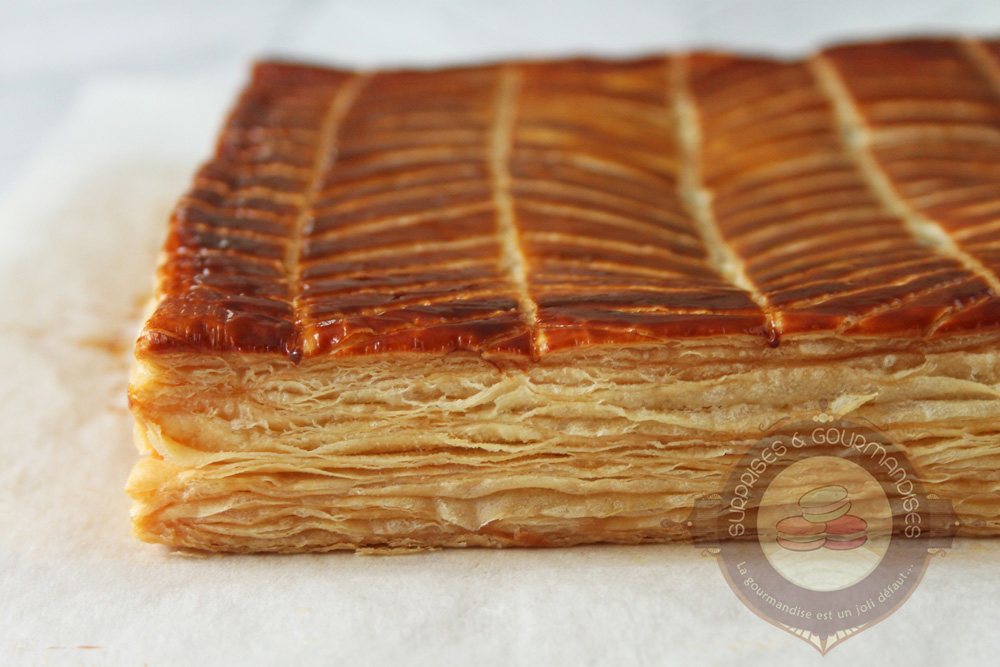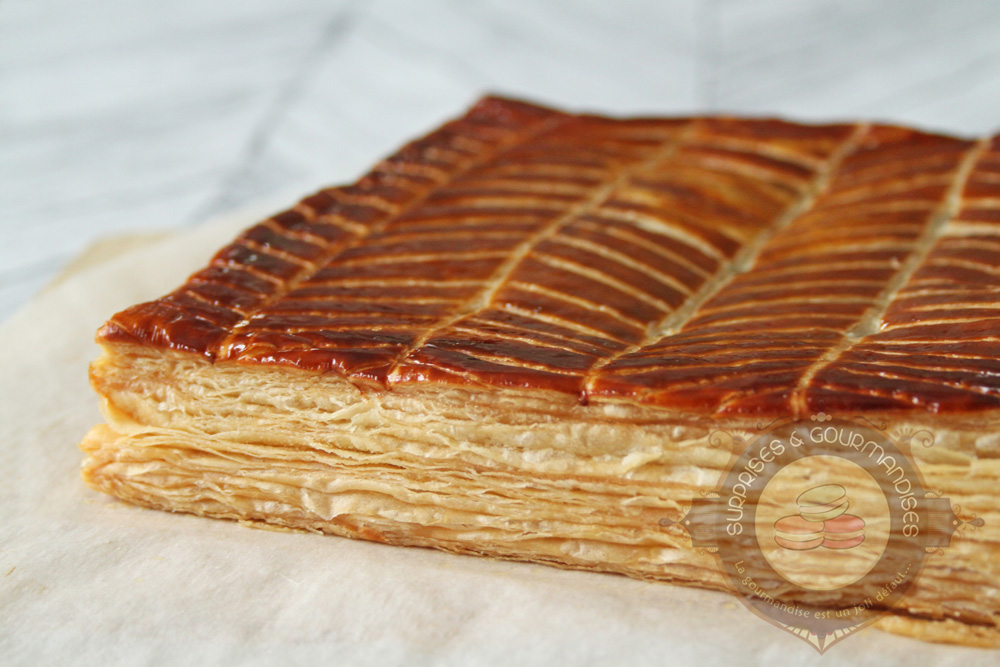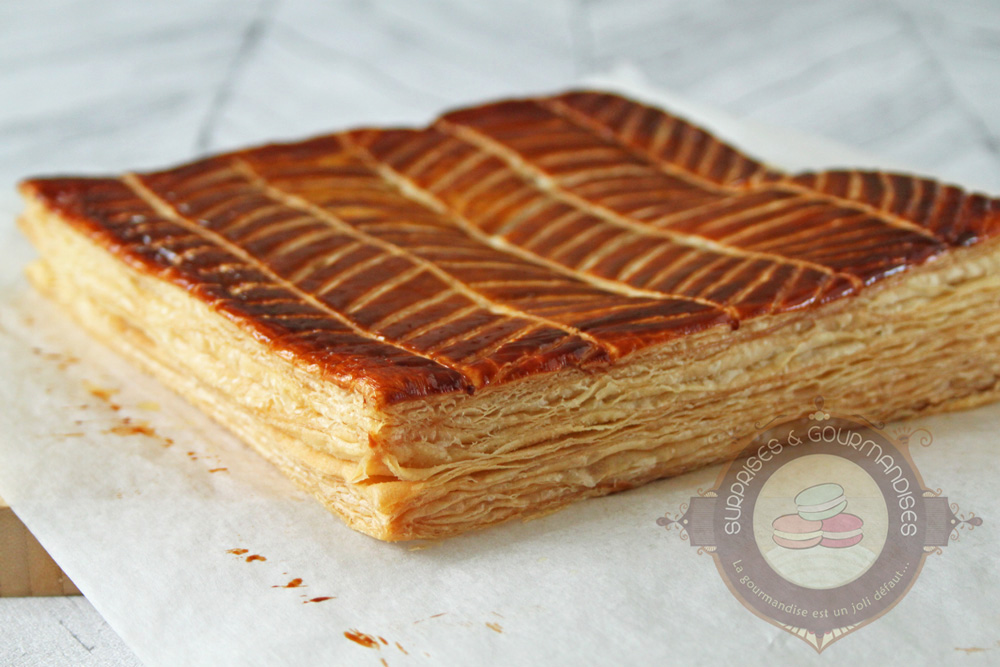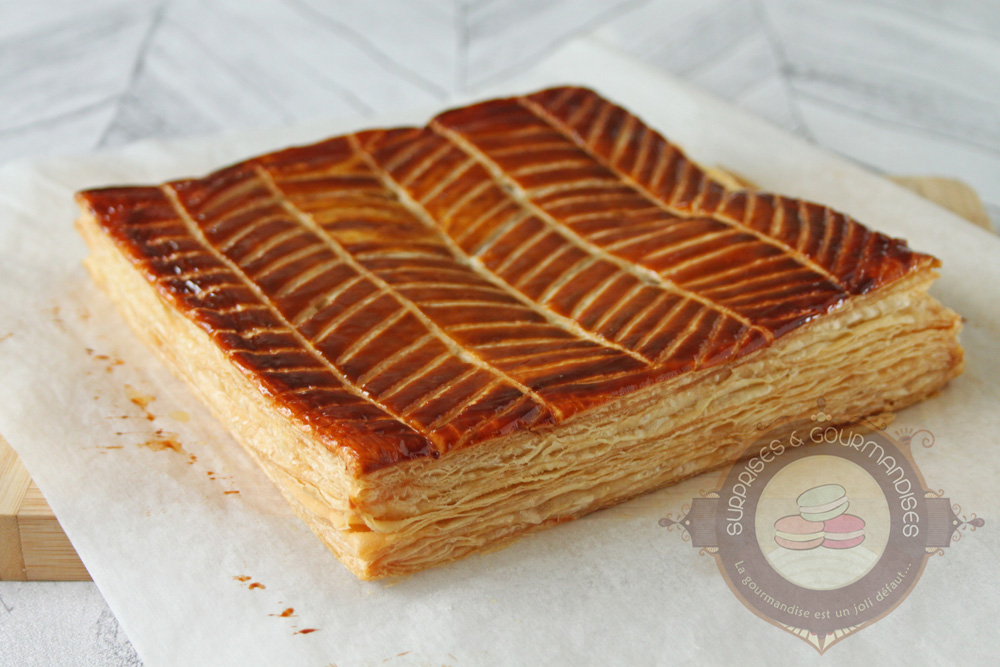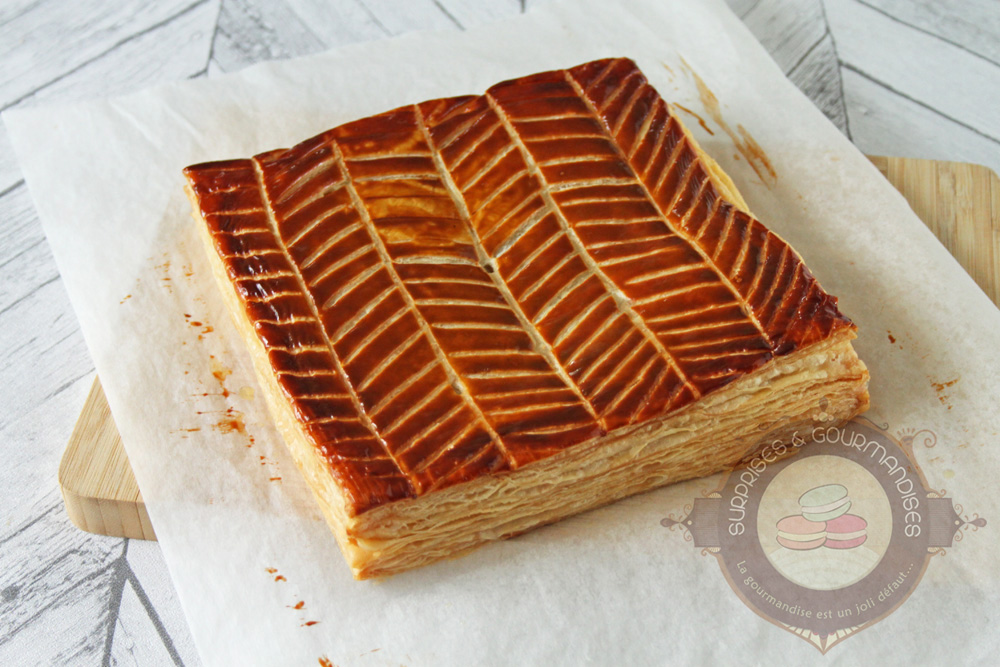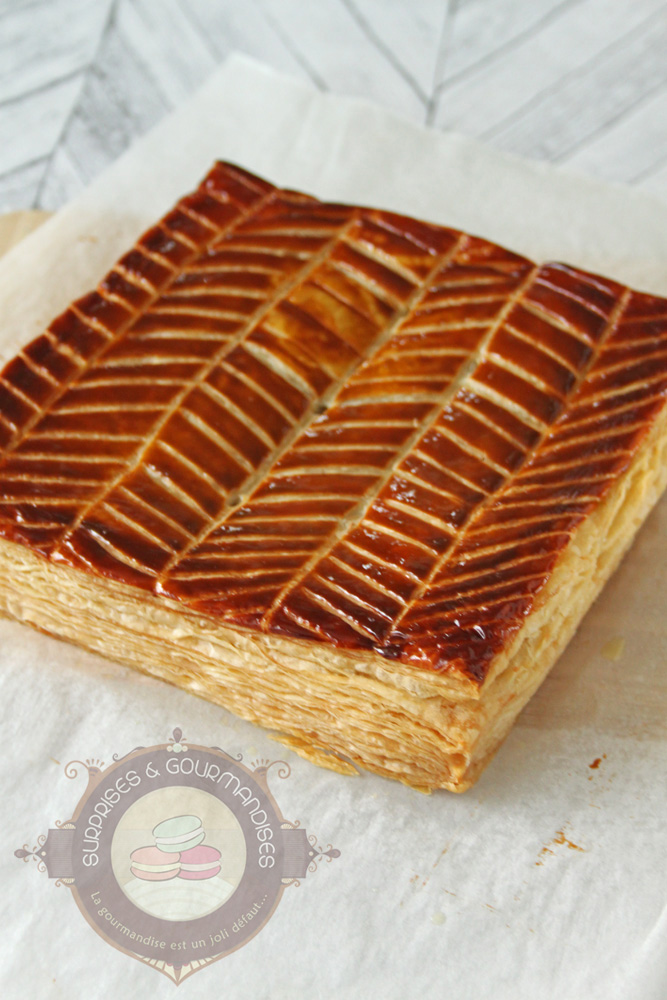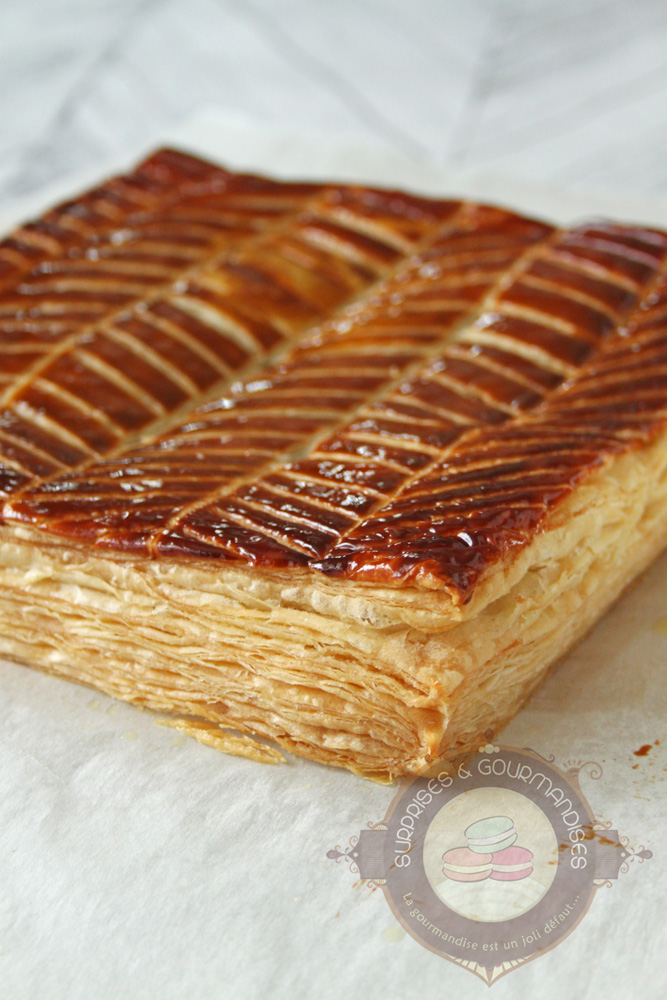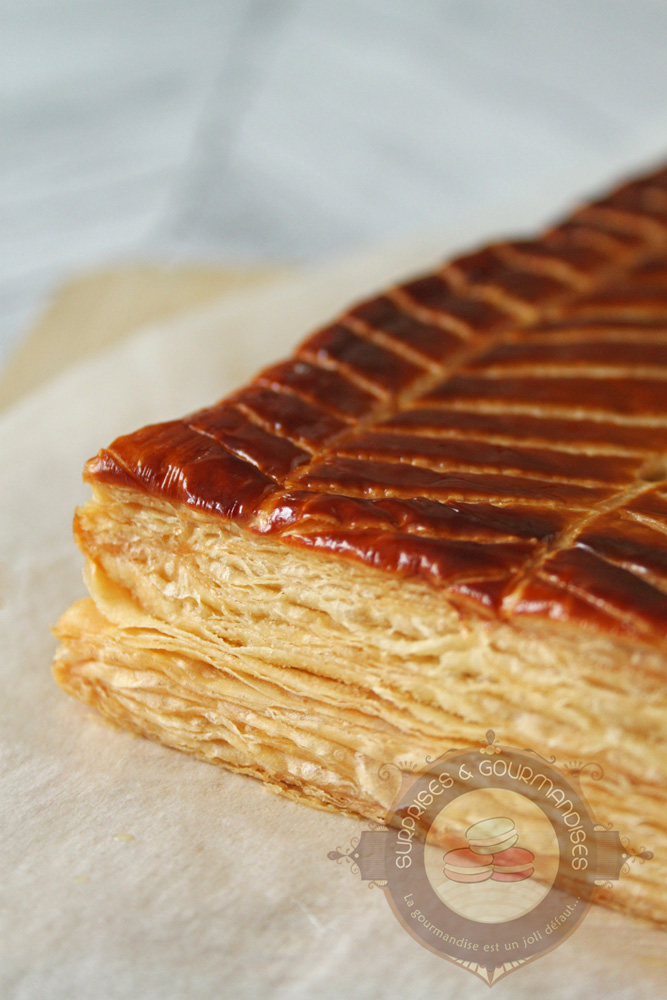



I don’t know about you, but as far as I’m concerned, we eat galettes des rois all through January. So I’m not going to hold back from sharing with you a new ultra-indulgent recipe, 200% approved by myself and my colleagues: a 100% hazelnut galette des rois, in which you’ll find a hazelnut frangipane, of course, but also hazelnut praline and chopped hazelnuts.
This galette was made with an inverse puff pastry (I published the recipe last weekend). When it comes to making a galette, I’d like to tell you to forget classic puff pastry. The inverse version is not only easier to make and more pleasant to work with, but it’s also incredibly melt-in-the-mouth. I strongly advise you to try it if you haven’t already.
For this one, I wanted to try the square version, for a change from the traditional perfectly round galette. I really like the result. And if you want to know everything, it’s a galette I’d made in early January and frozen. In that case, you just need to take the galette out a few hours beforehand, apply the 2 egg washes and then bake it. I didn’t crimp the galette and I had no leaks at all (same for the 2nd hazelnut galette I’d also made) — something tells me the freezing must have helped a little.
I still plan to enjoy one or 2 galette(s) with the family, but for the recipes, you’ll have to wait until next year ^^ In the meantime, you can already find several recipes on the blog, each as delicious as the next.
Ingredients & method
5 components · Full recipe
Hazelnut praline
Ingredients
- 150 g (5.3 oz) hazelnuts
- 100 g (3.5 oz) sugar
- 25 g (0.9 oz) water
- 1 small pinch of fleur de sel
Method
1
Toast the hazelnuts in the oven for approximately 15 minutes at 150°C / 300°F.
2
In a heavy-bottomed saucepan or cast-iron casserole, bring the water and sugar to a boil. At 116°C / 241°F, off the heat, pour the nuts into the liquid sugar and stir so the sugar coats all the nuts. The mixture will turn whitish — this is normal.
3
Return to medium heat and stir continuously until the sugar melts again and caramelises (this takes around 20 minutes). Do not stop stirring, or the nut mixture may burn.
4
At the end of cooking, the nuts will be glossy and an attractive auburn colour. Spread them on parchment paper and allow to cool.
5
Once everything is completely cold, break up the nut brittle and place it in a food processor with the fleur de sel.
6
Blend, taking regular breaks (to prevent the mixture from overheating), until you reach the consistency of a praline paste. The longer you blend, the more liquid it will become. You can choose to make an old-fashioned praline with some texture, or blend it until completely smooth.
7
Store in an airtight jar.
Pastry cream (you’ll have some left over, but you can make another king cake)
Ingredients
- 125 g (4.4 oz) milk (whole, preferably)
- 30 g (1.1 oz) sugar
- 30 g (1.1 oz) egg yolks (2 yolks)
- 12 g (0.4 oz) cornflour
- 12 g (0.4 oz) butter
- 1/2 vanilla pod
Method
1
In a small saucepan, heat the milk with the split and scraped vanilla pod and half the sugar (30 g (1.1 oz)).
2
In a bowl, combine the egg yolks and remaining sugar, then whisk until the mixture lightens in colour.
3
Add the cornstarch and mix.
4
Pour half the hot milk in a thin stream while whisking constantly, to loosen the cream. Return everything to the saucepan.
5
Whisk over medium heat for about 2 minutes, until the cream thickens.
6
Off the heat, add the cold butter and whisk vigorously.
7
Transfer to a dish and cover with plastic wrap directly on the surface. Cool rapidly. The faster it cools, the longer the pastry cream will keep.
Hazelnut cream
Ingredients
- 65 g (2.3 oz) icing sugar
- 1 egg
- 65 g (2.3 oz) hazelnut powder
- 50 g (1.8 oz) soft butter
- 15 g (0.5 oz) hazelnut paste (or hazelnut praline, as I use)
- 5 g (0.2 oz) cornstarch
- 5 g (0.2 oz) kirsch (optional)
- 1 pinch of fleur de sel
Method
1
Place the softened butter in a bowl and work it first with a spatula to soften it, then finish with a whisk to obtain a smooth and creamy texture.
2
Add the hazelnut paste (or hazelnut praline), cornstarch, and egg. Mix with the whisk.
3
Then add the sifted icing sugar, the kirsch, and the hazelnut powder.
4
Stir with a spatula until you have a smooth, even mixture, but do not whisk for too long. Set aside in the fridge.
Hazelnut frangipane cream
Ingredients
- the hazelnut cream from above
- 65 g (2.3 oz) pastry cream
Method
1
In a bowl, smooth out the cooled pastry cream using a whisk.
2
Fold the pastry cream into the hazelnut cream and mix briefly. If you whisk the frangipane for too long, it will puff up during baking.
3
Transfer the hazelnut frangipane to a piping bag fitted with a 1 cm (0.4 in) plain nozzle. Refrigerate until needed.
Assembling the 100% hazelnut king cake
Ingredients
- 2 discs of reverse puff pastry (recipe here)
- the hazelnut frangipane cream
- the hazelnut praline
- chopped hazelnuts
- sugar syrup
- 1 fève (hidden charm)
Method
1
Cut out 2 rounds of inverted puff pastry measuring 22–24 cm (9.4 in) in diameter.
2
Place a disc of pastry on a sheet of parchment paper, itself set on a baking tray (this makes it much easier to move later on).
3
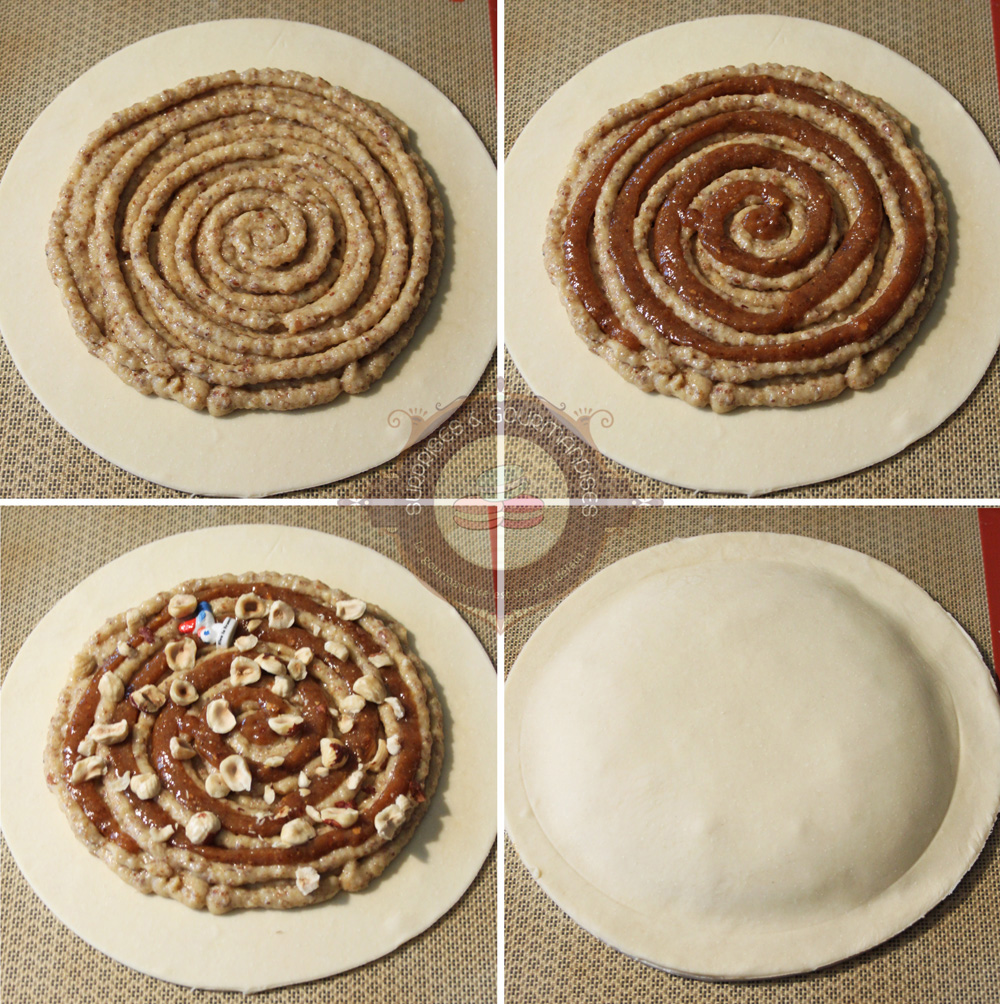
Pipe the hazelnut frangipane in concentric circles starting from the centre of the galette, leaving about 3 cm (1.2 in) free around the edge.
4
Then pipe a swirl of hazelnut praline over the frangipane.
5
Scatter over the crushed hazelnuts, then press the lucky charm towards the outside edge.
6
Humidifier le bord de la galette avec un peu d’eau (l’espace sans frangipane).
7
Carefully cover with the second round of puff pastry, making sure the two pastry pieces are properly aligned.
8
Seal the two pastry discs together by pressing lightly, making sure to push the frangipane inwards. You can crimp the edge with a knife to prevent the galette from opening (using the back of a small knife, score all the way around). I now try not to do this for a neater look, though there is a small risk it may open.
9
Remove the galette from the fridge and flip it so the flat side faces up (the domed side is therefore in contact with the parchment paper).
10
Mix an egg yolk with a tiny amount of liquid cream (typically 4 g (0.1 oz) of cream per yolk).
11
Egg-wash the top of the galette once and leave to rest in the fridge for about 20 minutes. Egg-wash a second time, then refrigerate while you preheat the oven. Be careful not to get egg wash on the edges, as this would prevent the pastry from rising properly. Preheat the oven to 170°C / 340°F.
12
Remove the galette from the fridge and score the top with the back of a knife. Pierce a hole right in the centre to allow steam to escape, then make a few more holes in other places.
13
Bake for approximately 35–40 minutes, then lower the oven temperature to 160°C / 325°F and bake for a further 5 minutes. Keep a close eye on the last few minutes to prevent the galette from over-colouring.
14
While the galette is baking, prepare a sugar syrup (20 g (0.7 oz) of water and 20 g (0.7 oz) of sugar, brought to a boil in a saucepan, then left to cool).
15
As soon as it comes out of the oven, brush the top of the galette with the syrup and leave to cool on a wire rack.

Gallery