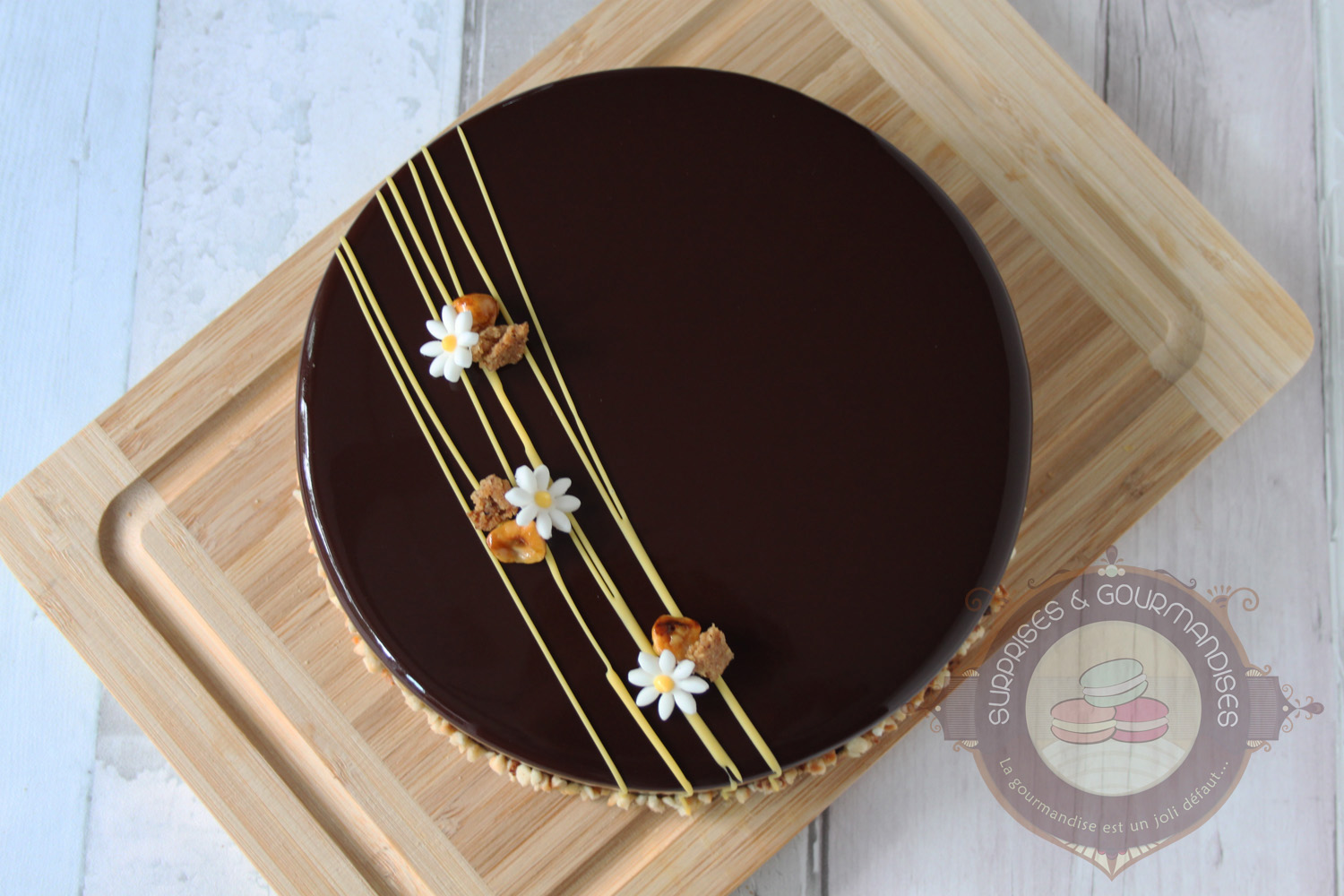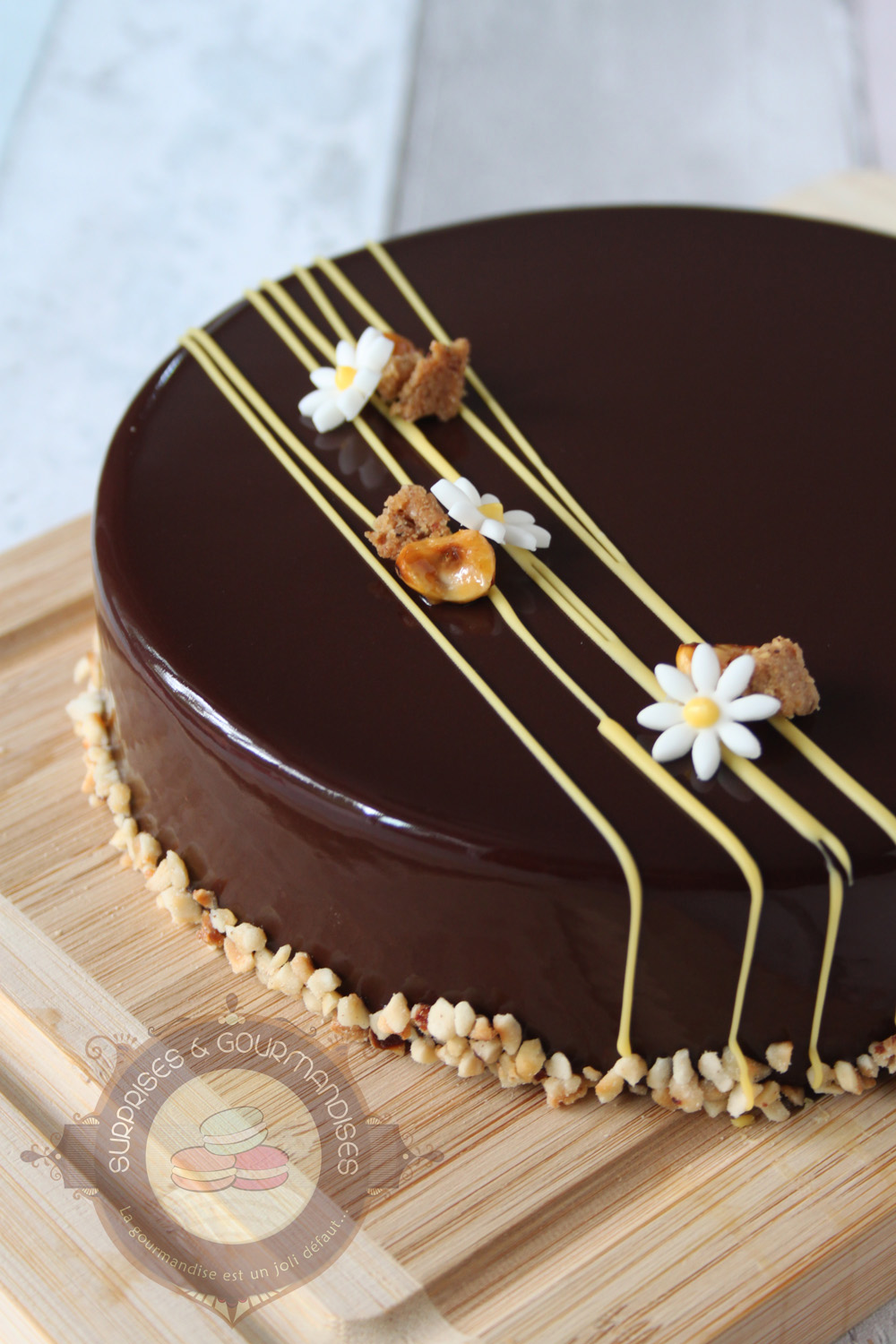



Here is a hazelnut yuzu entremets that I’m particularly proud of. It’s made up of a hazelnut streusel, a soft hazelnut sponge, a lemon yuzu crémeux and a gianduja mousse.
I treated myself to a “little” something and bought myself the Bamix hand blender. I had the chance to test it during my entremets course last summer and I was blown away by how effective it is.
I took advantage of a private sale to get it before Christmas. Some will say that the quality of the glaze has nothing to do with the hand blender… Personally, I disagree.
It’s the first time I’ve got such a shiny mirror glaze, without a single bubble. It was simply perfect. In short, it’s night and day. We’re going to go a long way together, little Bamix!
For the record… we enjoyed this dessert at friends’ house. It was cold, so the dessert waited patiently on the balcony. When it came time to fetch it (in its carry box), I slipped. I can’t even begin to tell you about the flight it took! My dessert thought it was a tarte tatin and ended up on the balcony’s artificial grass, upside down. We laughed!!! And I was so proud of my glaze. I rescued it as best I could, stripped it of its beautiful glaze, now embedded with bits of dirt from outside… in short, sorry, but this time there are no photos of the inside.
Back to the entremets. I tested the hazelnut and yuzu combination for the first time (in entremets form I mean, since I had already made hazelnut yuzu macarons). I had bought some yuzu juice online a while ago and I had some Valrhona milk gianduja left in the fridge. I had everything I needed.
For the recipe, I wanted to try the recipe by David Zanni, who won the show Les rois du gâteau last year and had the chance to have his dessert sold in the Fou de Pâtisserie shop.
You can dive into making this dessert with your eyes closed. It’s a delight! Hazelnut and yuzu go together wonderfully. For those wondering, yuzu juice is easy to find online (look on the Meilleur du chef website for example). It is obviously a bit more expensive (€8-9 for 100g of juice) but oh, that flavour!!! It’s truly a citrus fruit worth discovering. And for those who balk at the idea of spending such a sum on 100g of juice, you can make this recipe with lemon juice. And if you don’t have any gianduja, you can use Pralinoise chocolate instead. The praline lemon pairing needs no further proof.
Ingredients & Method
7 components · Full recipe
Mirror glaze (can be made ahead)
Ingredients
- 120 g (4.2 oz) water
- 150 g (5.3 oz) sugar
- 50 g (1.8 oz) unsweetened cocoa powder
- 100 g (3.5 oz) heavy cream
- 10 g (0.4 oz) gelatin
- 60 g (2.1 oz) water (to rehydrate the gelatin)
Method
1
Rehydrate the gelatin in very cold water.
2
Put all the ingredients in a saucepan and mix with a whisk.
3
Bring to a boil for 2 minutes, stirring constantly.
4
Add the rehydrated gelatin and blend with an immersion blender.
5
Cover with cling film touching the surface and refrigerate.
Hazelnut streusel (to be made the day before)
Ingredients
- 40 g (1.4 oz) butter
- 40 g (1.4 oz) brown sugar
- 50 g (1.8 oz) toasted hazelnut powder
- 40 g (1.4 oz) flour
- zest of 1 lemon
- 0.5 g (0 oz) fleur de sel
Method
1
In a bowl, mix the softened butter, brown sugar, sifted flour, hazelnut powder, the zest of one lemon, and fleur de sel until you get a smooth ball of dough.
2
Roll the dough out to 3–4 mm thickness between two sheets of parchment paper.
3
Rest in the refrigerator for half an hour.
4
Preheat the oven to 160°C / 325°F.
5
Cut out an 18 cm (7.1 in) diameter circle. Keep the ring on and bake for 15 minutes.
Hazelnut soft cake (to be made the day before)
Ingredients
- 50 g (1.8 oz) hazelnut powder
- 30 g (1.1 oz) brown sugar
- 50 g (1.8 oz) egg
- 11 g (0.4 oz) icing sugar
- 11 g (0.4 oz) heavy cream
- zest of 1 lemon
- 47 g (1.7 oz) butter
- 25 g (0.9 oz) flour
- 2.8 g (0.1 oz) baking powder
- 50 g (1.8 oz) egg white
- 8.3 g (0.3 oz) brown sugar
Method
1
While the streusel is baking, prepare the hazelnut soft cake.
2
In a bowl, mix the previously toasted hazelnut powder, the zest of one lemon, the brown sugar, the egg, the icing sugar, and the heavy cream.
3
Melt the butter in a saucepan until it turns a hazelnut color, stirring constantly. The butter is ready when it has a delicious hazelnut aroma and stops sizzling. Add it while still hot to the rest of the ingredients, continuing to mix.
4
Add the sifted flour and baking powder.
5
Whip the 50 g (1.8 oz) of egg whites to stiff peaks, tightening them with the 8.3 g (0.3 oz) of brown sugar, then gently fold them into the first mixture using a spatula.
6
Pour the batter over the streusel, being careful not to add too much (the cake will rise during baking).
7
Bake again for 15 minutes at 180°C / 350°F. Once out of the oven, leave to cool on a wire rack (keeping the ring on).
Lemon yuzu cream (to be made the day before)
Ingredients
- 110 g (3.9 oz) whole eggs
- 100 g (3.5 oz) sugar
- 32 g (1.1 oz) lemon juice
- 38 g (1.3 oz) yuzu juice
- zest of 1 lemon
- 80 g (2.8 oz) butter
- 1 g (0 oz) gelatin (½ sheet)
Method
1
Soak the gelatin in cold water.
2
Pour the lemon juice and yuzu juice into a saucepan, then add the eggs, sugar, and lemon zest. Mix together with a whisk.
3
Heat to 83°C / 181°F, stirring constantly. The cream will thicken. As with cooking a custard, be careful not to exceed this temperature. If you don’t have a thermometer, here is Chef Michalak’s tip: whisk the mixture quickly then stop — if the swirl stops immediately, the cream is at the right temperature. Add the squeezed gelatin and mix.
4
When the lemon cream is around 35°C / 95°F, pour it into a tall container (I use a jug). Add the cold butter all at once, then blend with an immersion blender. The cream should be smooth and will lighten slightly.
5
Pour over the hazelnut soft cake to a depth of about 1 cm (you should have a little cream left over). Freeze for at least 3 hours, or ideally overnight.
Gianduja mousse
Ingredients
- 140 g (4.9 oz) milk
- 64 g (2.3 oz) egg yolks
- 20 g (0.7 oz) sugar
- 200 g (7.1 oz) Valrhona milk gianduja
- 200 g (7.1 oz) heavy cream
- 5 g (0.2 oz) gelatin
Method
1
Rehydrate the gelatin in very cold water.
2
In a saucepan, heat the milk.
3
In a bowl, whisk the egg yolks with the sugar, then pour the hot milk over the yolk-sugar mixture, mix well and return everything to the heat.
4
Cook to 83°C / 181°F, stirring constantly with a spatula. Be careful not to let the mixture boil.
5
Off the heat, add the rehydrated gelatin.
6
Pour a first third over the melted gianduja and mix to create an emulsion. Then add the second and third portions to obtain a smooth mixture. Blend with an immersion blender and set aside.
7
Whip the heavy cream but don’t over-whip it — it should be light and mousse-like.
8
When the gianduja cream has cooled to 35°C / 95°F, gently fold in the whipped cream, then set aside.
Hazelnut yuzu entremet assembly
Ingredients
- None
Method
1
Wrap the inside of a 20 cm (7.9 in) diameter ring with cling film.
2
Pour in the gianduja mousse and spread it up the sides for a clean finish.
3
Remove the insert from the freezer (streusel / soft cake / cream) and gently press it into the mousse, centered, with the cream side facing down into the mousse.
4
Smooth the surface with a spatula.
5
Cover with cling film and freeze for at least 3 hours, ideally overnight.
Decoration
Ingredients
- sugar paste flowers
- a few caramelized hazelnuts
- small pieces of hazelnut streusel
Method
1
Remove the entremet from the freezer and unmold (I warm the sides of the ring with a hair dryer to make this easier).
2
Place the frozen entremet on a wire rack, with the rack set on a plate or tray to catch the excess glaze.
3
Warm the cocoa mirror glaze in the microwave to around 28–30°C / 86°F and gently pour it over to coat the entremet completely.
4
Remove the entremet from the rack and decorate the base with hazelnut pieces all around the edge.
5
Melt some white chocolate and color it with yellow oil-soluble food coloring. Place in a piping cone. Draw lines on one side of the entremet.
6
Place on a serving dish and finish the decoration with a few caramelized hazelnuts, small pieces of hazelnut streusel, and sugar paste flowers (the yellow on the flower is made with the colored white chocolate).
7
Leave to thaw in the refrigerator. Allow about 5–6 hours for defrosting.

Gallery