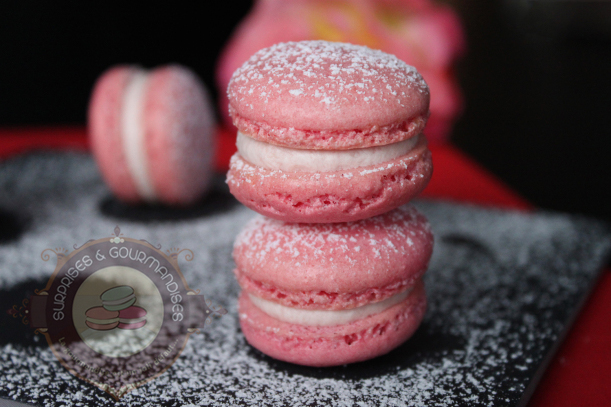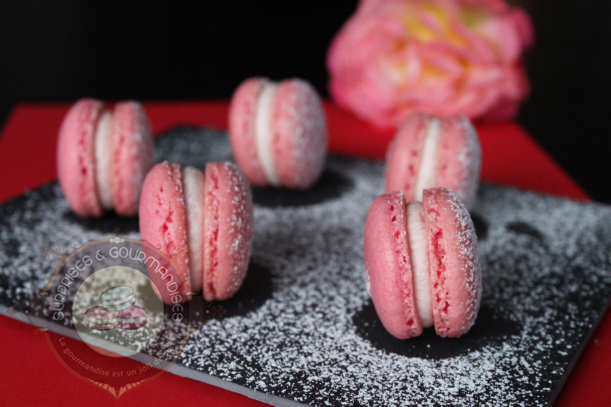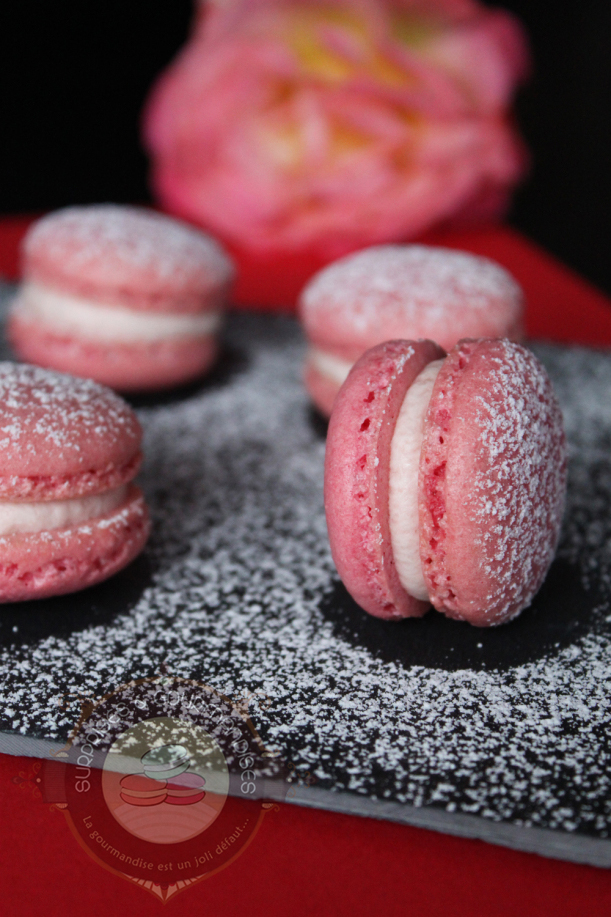


I’m slowly catching up on my backlog of posts with a macaron recipe! These were made during the autumn half-term holidays and I took them with me on holiday to my in-laws (I never arrive empty-handed ^^). Everyone enjoyed them, including my other half’s nieces, who love macarons! I took the recipe from Emilie (a contestant on Le Meilleur Pâtissier) on her blog Pâtisserie et gourmandise.
I wasn’t quite sure how much hibiscus flower to use. In the end, the rose dominated the hibiscus. The taste of rose, like other floral flavours, is quite particular — you have to like it, which isn’t really my case 😉 But I like trying new things. In fact, I’d really like to try poppy or violet!
Ingredients & preparation
3 components · Full recipe
Shells
Ingredients
- 70 g (2.5 oz) egg whites
- 140 g (4.9 oz) powdered sugar
- 80 g (2.8 oz) almond flour
- 20 g (0.7 oz) caster sugar
- pink food coloring
Preparation
1
Blend the powdered sugar and almond flour together, then sift the mixture.
2
Whip the egg whites to stiff peaks, adding the caster sugar in two additions and beating at maximum speed to achieve the “bird’s beak” stage. Add a small amount of pink powdered food coloring and mix again.
3
Gradually fold in the almond flour and powdered sugar mixture using a rubber spatula. The batter should be glossy, smooth, and fall in a ribbon. Once the right consistency is reached, transfer the batter to a piping bag fitted with a plain tip. Don’t hesitate to use a tall glass to support your piping bag — that way you can use both hands.
4
Pipe small domes of about 3.5 cm (1.4 in) in a staggered pattern onto a sheet of parchment paper. For even macarons, I use a template downloaded from Pure Gourmandise. Let the shells rest for about 20 minutes. If after an hour the surface of your macarons is still not dry, there is a good chance they won’t form a skin at all. There can be several reasons for this — in any case, there’s no point in waiting any longer. Bake them anyway, but be prepared for the possibility that they won’t have a foot 😉
5
Bake at 120°C / 250°F for 20–22 minutes. Once out of the oven, let the shells cool completely before removing them from the parchment. The shells are done when they come off very easily.
Step by step
Not quite comfortable with macaron shells yet? I’ve put together two full step-by-step picture guides to help you get it right every time:
Rose Hibiscus Ganache
Ingredients
- 100 g (3.5 oz) white chocolate
- 40 g (1.4 oz) heavy cream
- 2 tablespoons rose water
- 3 candied hibiscus flowers
- 6 g (0.2 oz) maquis honey (or other mild honey)
Preparation
1
In a small saucepan, heat the heavy cream with the honey.
2
Meanwhile, break the white chocolate into pieces in a bowl (you can melt it slightly in a bain-marie or in the microwave).
3
As soon as the cream simmers, pour one-third over the white chocolate and stir to create an emulsion. Then add the second third, followed by the last third, until you have a smooth, homogeneous mixture.
4
Add the rose water and the hibiscus flowers finely diced into small cubes (brunoise). The pieces need to be small enough to pass through the piping tip when filling the macaron shells.
5
Refrigerate for a few hours.
Assembly
Ingredients
- None
Preparation
1
Sort your macarons so that the ones you pair together are the same size.
2
Using a piping bag fitted with a plain tip, pipe a dollop of rose hibiscus ganache onto the center of one shell, then sandwich with a second shell.
3
Refrigerate the macarons and wait 24 to 48 hours before enjoying them. The macarons should spend the first night in an uncovered container (to prevent them from becoming soggy), then close the box and keep them in the fridge for another 24 hours. They will only be better for it.
Gallery