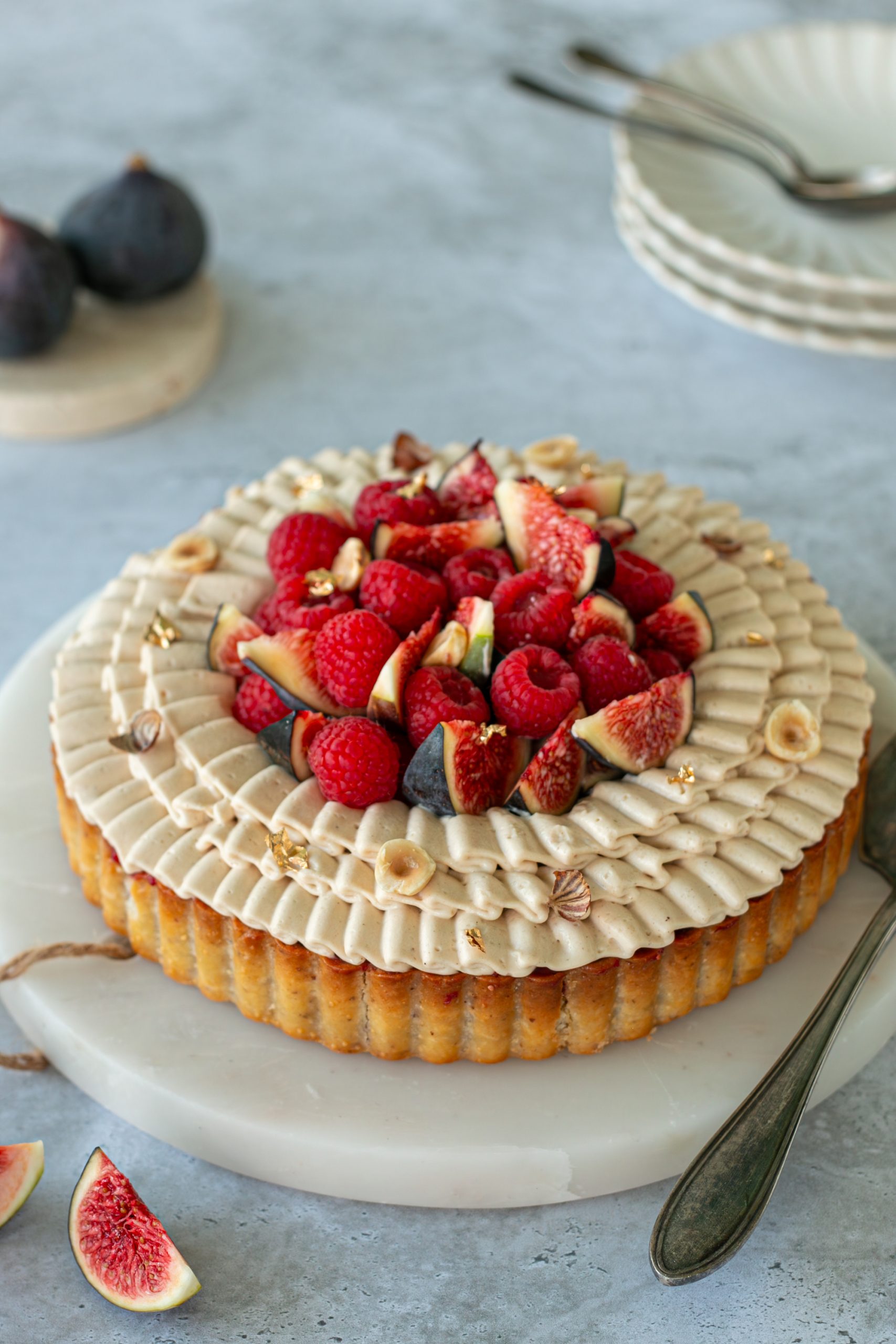



Here’s a new recipe to share with you today. Autumn has arrived and with it, fig season! I must confess that I wasn’t a fan of figs at all before. I’d never really eaten them because the texture put me off a little. But this year, I decided to give them a real chance and what a lovely discovery! These fruits have a truly delicious flavour, but their season is short: only a few weeks to make the most of them.
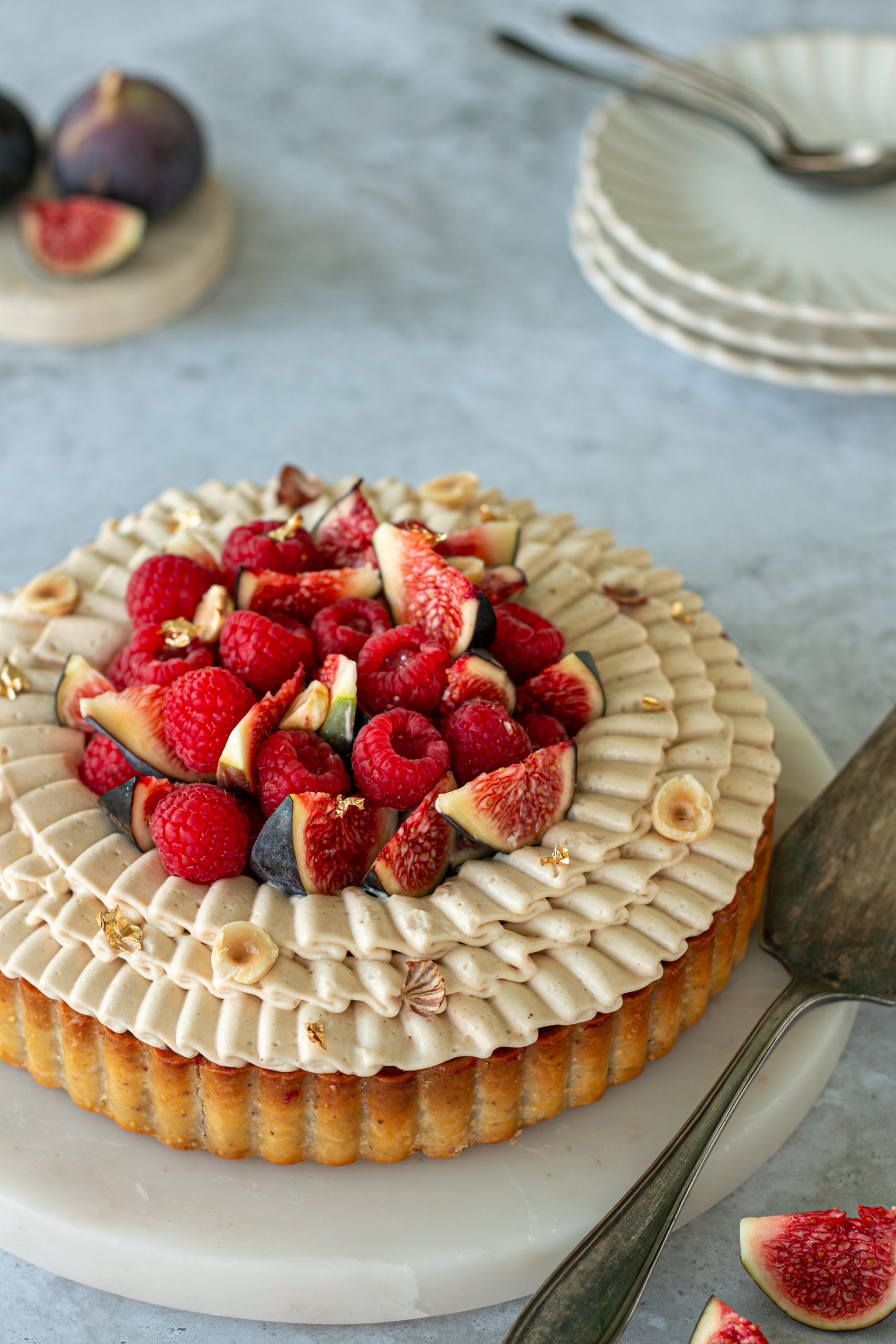
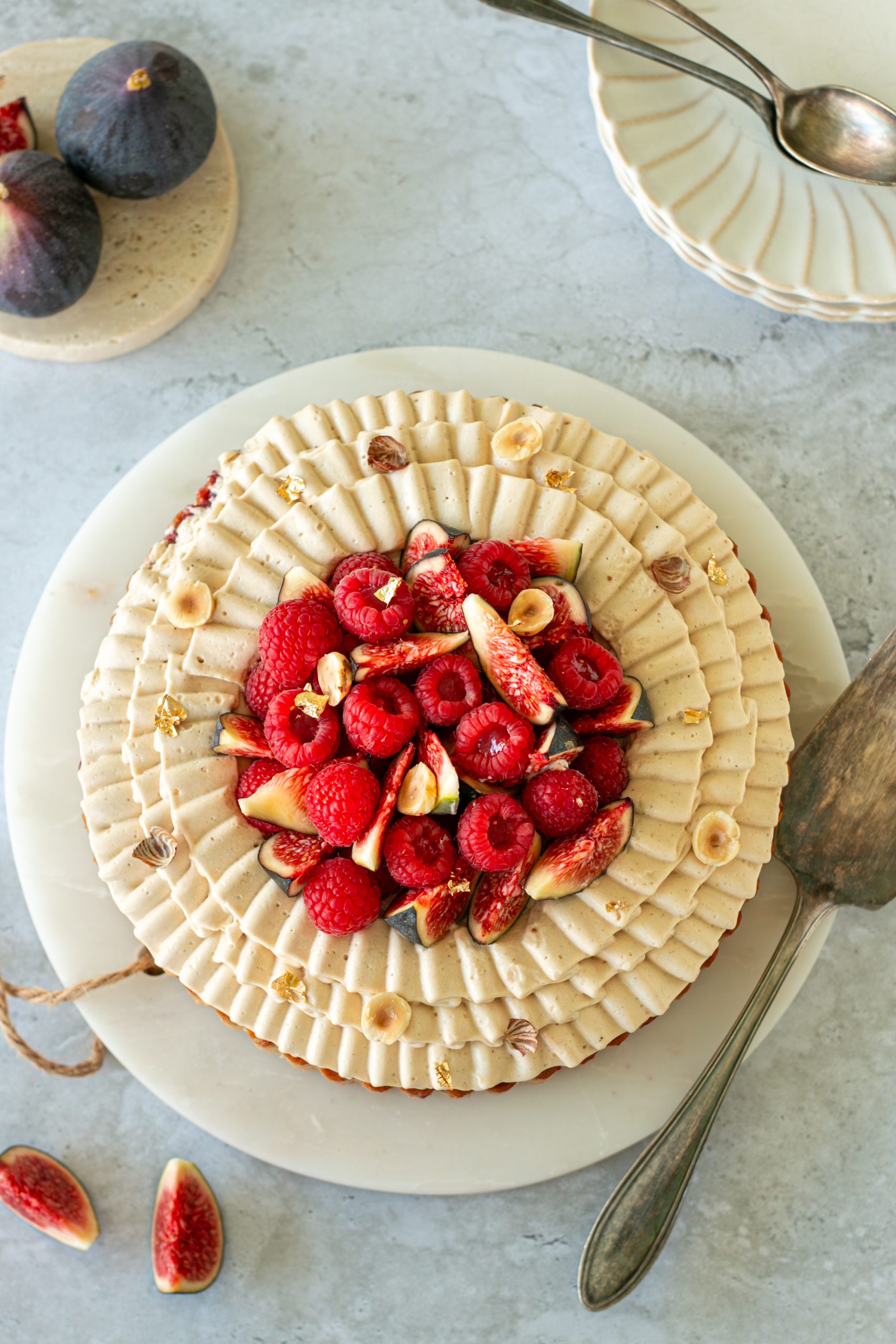
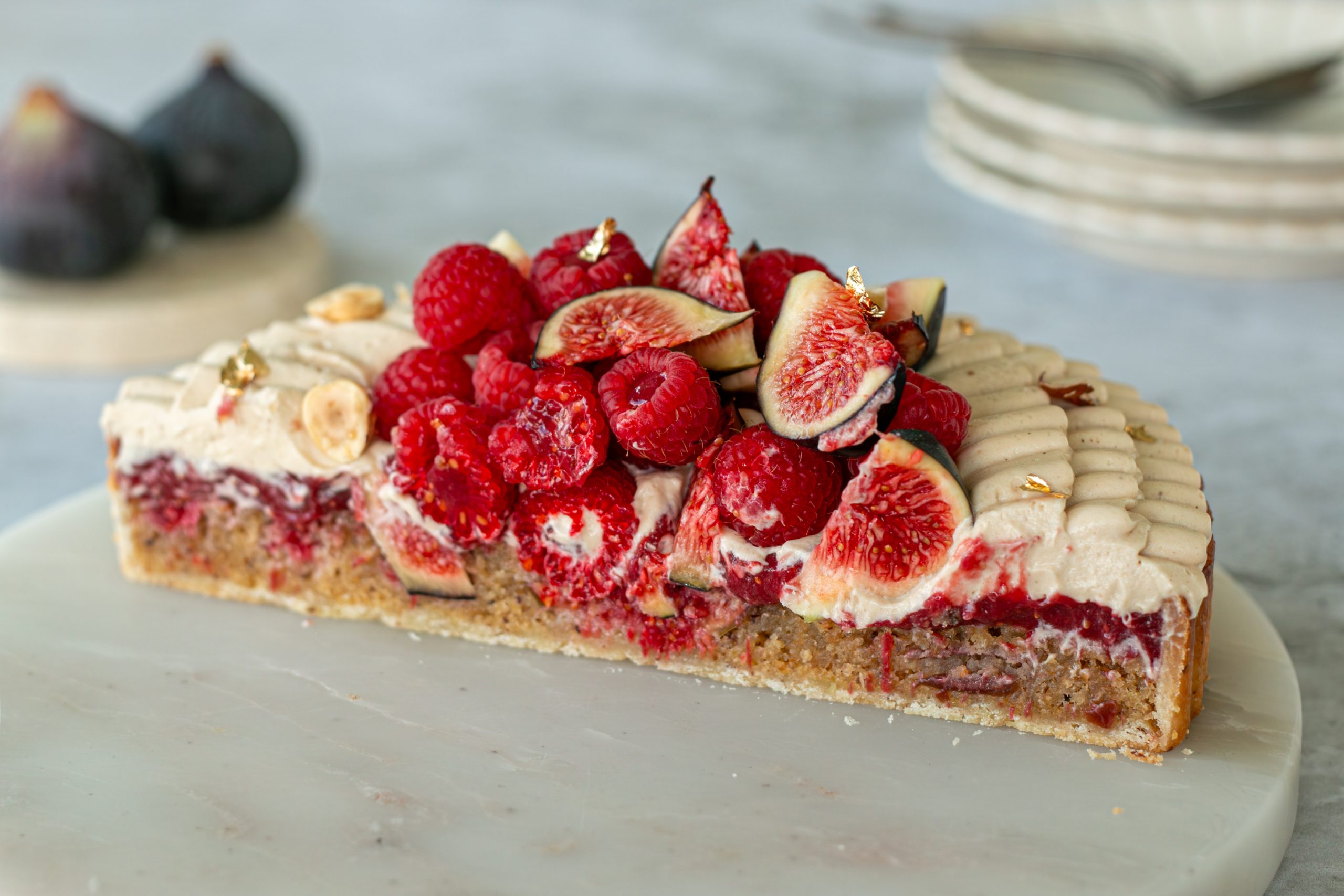
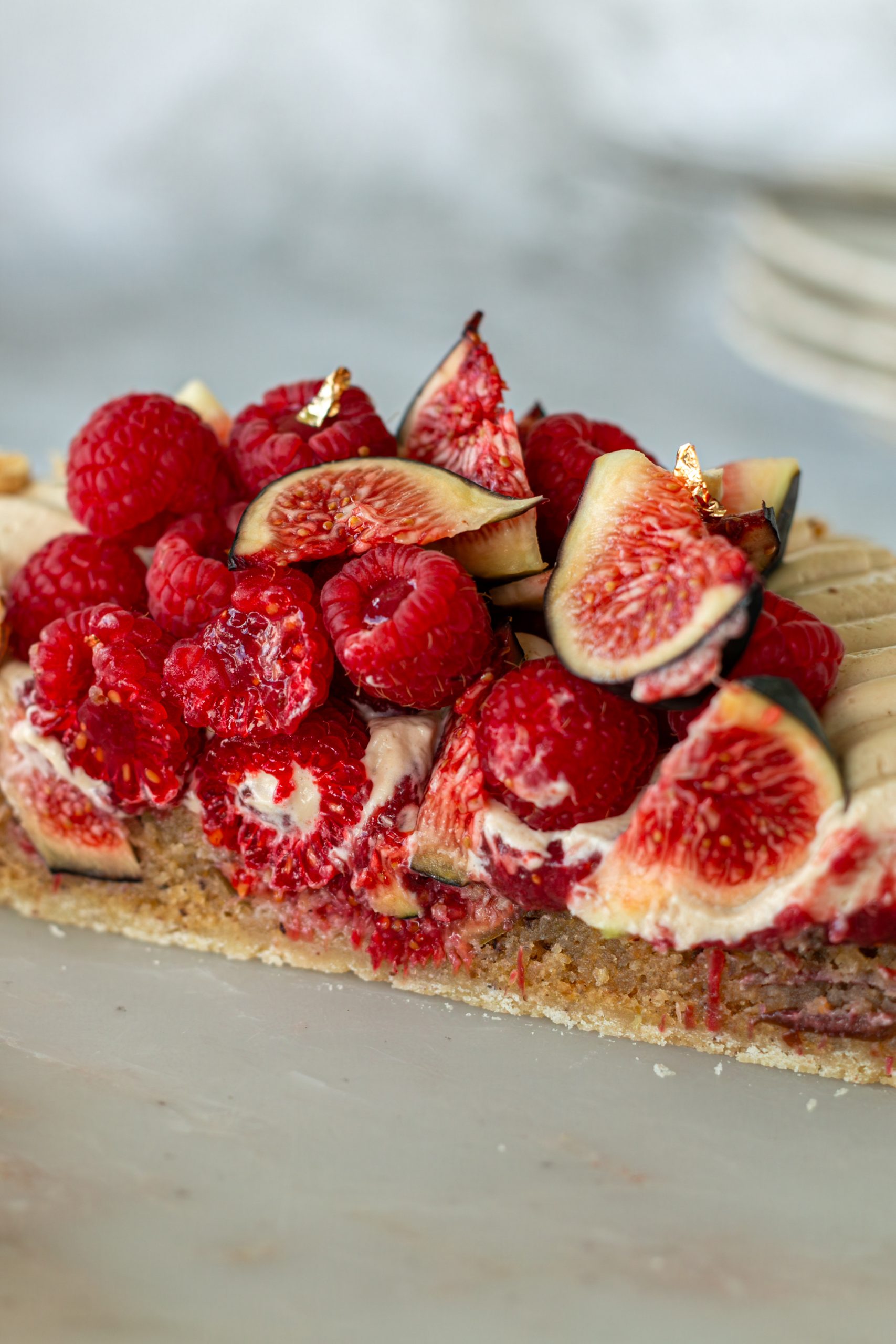
So I wanted to create a tart that would show them off, pairing them with raspberries for their acidity and hazelnuts for indulgence. This tart is made up of a pâte sucrée, a hazelnut cream studded with fresh figs and raspberries, a fig and raspberry confit, a hazelnut whipped ganache and fresh figs and raspberries. The result is truly flavoursome: the sweetness of the figs, the freshness of the raspberries and the indulgence of the hazelnuts. Really, this fig-raspberry pairing is absolutely delicious!
How do you make a successful pâte sucrée?
In pastry, everything starts with the base. A successful pâte sucrée is both crisp and light, with a melt-in-the-mouth texture that doesn’t dominate the other elements but supports them. It must be thin enough to leave plenty of room for the fillings, while remaining sturdy after baking. The secret lies in respecting the resting times, in careful baking and in attention to detail. Here are a few tips to get it right every time:
- The butter: it should be softened, not melted, supple but not liquid. If it’s too cold, the dough will be brittle, and if it’s too warm, it will be greasy and difficult to handle.
- Don’t incorporate too much air: when mixing butter and sugar, you shouldn’t whisk as you would for a génoise sponge. A dough with too much air puffs up during baking and loses its shape. The aim here is to get a smooth, creamy texture, but not a foamy one.
- Respect the order of incorporation: first the butter and sugar, then the ground almonds and salt, then the egg and finally the flour last. The flour comes at the end, just to bind without developing the gluten.
- Minimal working: Never “work” the dough for too long. As soon as it’s homogeneous, stop. If you knead it for too long, the dough becomes elastic and shrinks during baking.
- Resting is essential: Wrap the dough in cling film and leave it to rest for at least 2 hours in the fridge (or overnight). This allows the gluten to relax, the butter to firm up and the dough to be easier to handle.
- A well-chilled sheet of dough: Roll the dough out between two sheets of baking paper to avoid adding flour (which dries it out). If it becomes too soft, put it back in the fridge for 10 min before lining the ring.
- Controlled baking: Prick the tart base before baking and use baking paper and ceramic baking beads (or dried beans) to stop it puffing up. The oven must be well preheated (160 °C) for even baking.
- Finishing: for an ultra-neat base, run a microplane grater over the edges after baking to even them out. You can also lightly glaze with egg before baking for a shinier colour.
Why pair fig with raspberry?
Figs and raspberries are a combination you don’t necessarily imagine at first, but one that works really well. The fig brings its sweetness and softness, while the raspberry wakes everything up with its acidity. This pairing creates a lovely balance that gives character to every bite.
In this tart, I wanted to play with these fruits in different ways: you find them mixed into the hazelnut cream, turned into a confit and also arranged fresh on top. This allows for a variety of pleasures and textures.
Which hazelnut should you use?
The other star ingredient in this recipe is the hazelnut. For a quality hazelnut, you need to turn to the Piedmont hazelnut (from Italy), which is universally recognised as the best in the world. I personally use hazelnuts from the Pariani brand, certified Piedmont PGI and roasted right through to the core. This so-called uniform roasting method, using a machine that keeps the hazelnut turning continuously, intensifies the flavour and aroma of the hazelnut. They are also available on the Valrhona website. You really have to taste them at least once to understand… Their powerful, rounded and slightly roasted flavour brings an incomparable richness.
All that’s left is for you to get started and discover step by step this tart that brings together the best of autumn. So, get out your ripe figs, your tangy raspberries and your finest Piedmont hazelnuts 🙂

Ingredients & Method
6 components · Full recipe
Sweet Pastry (start 2 days or 1 day ahead)
Ingredients
- 150 g (5.3 oz) butter
- 95 g (3.4 oz) icing sugar
- 30 g (1.1 oz) Pariani hazelnut powder
- 60 g (2.1 oz) egg (one large egg)
- 250 g (8.8 oz) flour
- a pinch of fleur de sel
- a knife tip of vanilla powder
Method
1
Place the soft butter and icing sugar in the bowl of a stand mixer fitted with the paddle attachment and mix at low speed. Add the almond powder, vanilla powder and fleur de sel and mix again.
2
Add the beaten egg and mix with a spatula this time (it will be easier than with the stand mixer).
3
Finish with the flour and mix with the stand mixer until you get a smooth ball of dough. Do not overwork the pastry. Bring the dough together to form a ball without insisting. Divide the dough into 2 equal parts.
4
Wrap each piece of dough in cling film, flattening it into a rectangle. Place one piece in the fridge overnight and the other in the freezer (to make another tart).
5
The next day, roll out the dough to 2 mm thickness with a rolling pin. Cut out a piece of dough larger than your tart ring.
6
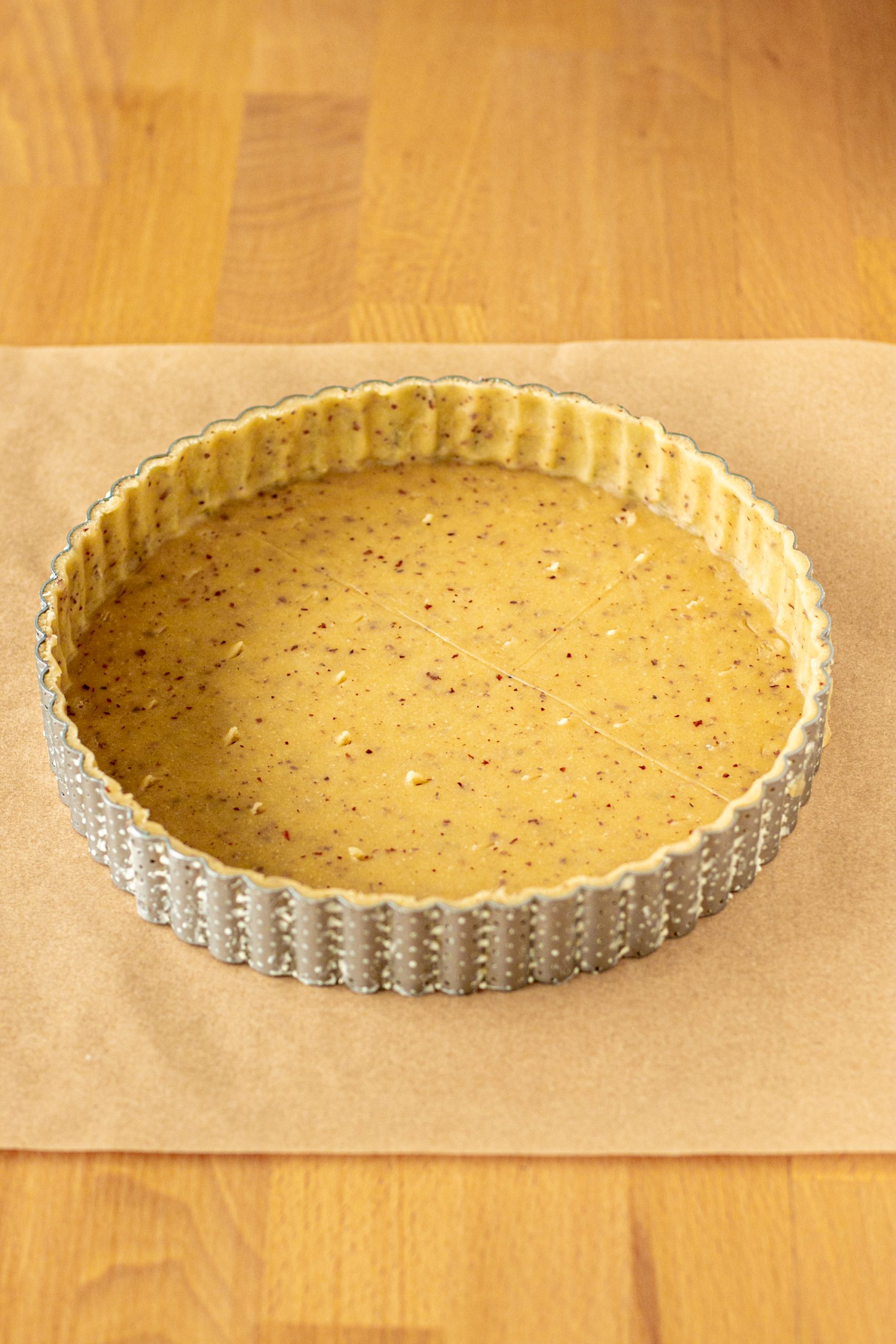
Grease an 18 to 20 cm (7.9 in) diameter ring then lay the dough in it, taking care to create a right angle.
7
Set aside in the fridge for at least 6 hours (overnight is ideal).
Whipped Hazelnut Ganache (make the day before)
Ingredients
- 63 g (2.2 oz) white chocolate
- 80 g (2.8 oz) full-fat double cream
- 170 g (6 oz) full-fat double cream, very cold
- 40 g (1.4 oz) hazelnut paste (or hazelnut praline, but it’s sweeter)
- 2 g (0.1 oz) powdered gelatine (= 1 leaf)
- 12 g (0.4 oz) water (to rehydrate the gelatine)
Method
1
Rehydrate the gelatine in the water.
2
Break the white chocolate into pieces in a bowl (you can melt it slightly in a bain-marie or microwave).
3
Heat the 80 g (2.8 oz) of cream and bring to the boil.
4
Off the heat, add the rehydrated gelatine and mix.
5
Pour one-third of the cream over the white chocolate and mix with a spatula to create an emulsion. Then add a second third, then a third, to obtain a smooth, homogeneous mixture.
6
Add the 170 g (6 oz) of very cold cream and the hazelnut praline, mix again. Blend for a few seconds with a hand blender to combine everything well. Cover with cling film in contact and refrigerate overnight.
Fig and Raspberry Confit (make the day before)
Ingredients
- 175 g (6.2 oz) figs
- 125 g (4.4 oz) raspberry purée
- 30 g (1.1 oz) caster sugar
- 4 g (0.1 oz) NH pectin
- a squeeze of lemon juice
Method
1
Cut the figs into quarters and place in a saucepan. Add the raspberry purée and heat over a medium heat.
2
Add the sugar/pectin mixture and bring to the boil for at least 1 minute.
3
Off the heat, add the lemon juice and leave to cool.
4
Cover with cling film in contact and refrigerate overnight.
Baking the Sweet Pastry
Ingredients
- None
Method
1
Preheat the oven to 160°C / 325°F.
2
Once the pastry is well chilled, trim the excess pastry with a small knife.
3
Place a sheet of baking parchment over the tart shell and place baking beads or dried beans on top to blind bake (normally, if the tart shell has spent the night in the fridge, you don’t need baking beads — the pastry won’t move).
4
Bake for approximately 15 minutes.
Hazelnut Cream
Ingredients
- 75 g (2.6 oz) soft butter
- 75 g (2.6 oz) icing sugar
- 8 g (0.3 oz) flour
- 75 g (2.6 oz) eggs
- 75 g (2.6 oz) Pariani hazelnut powder
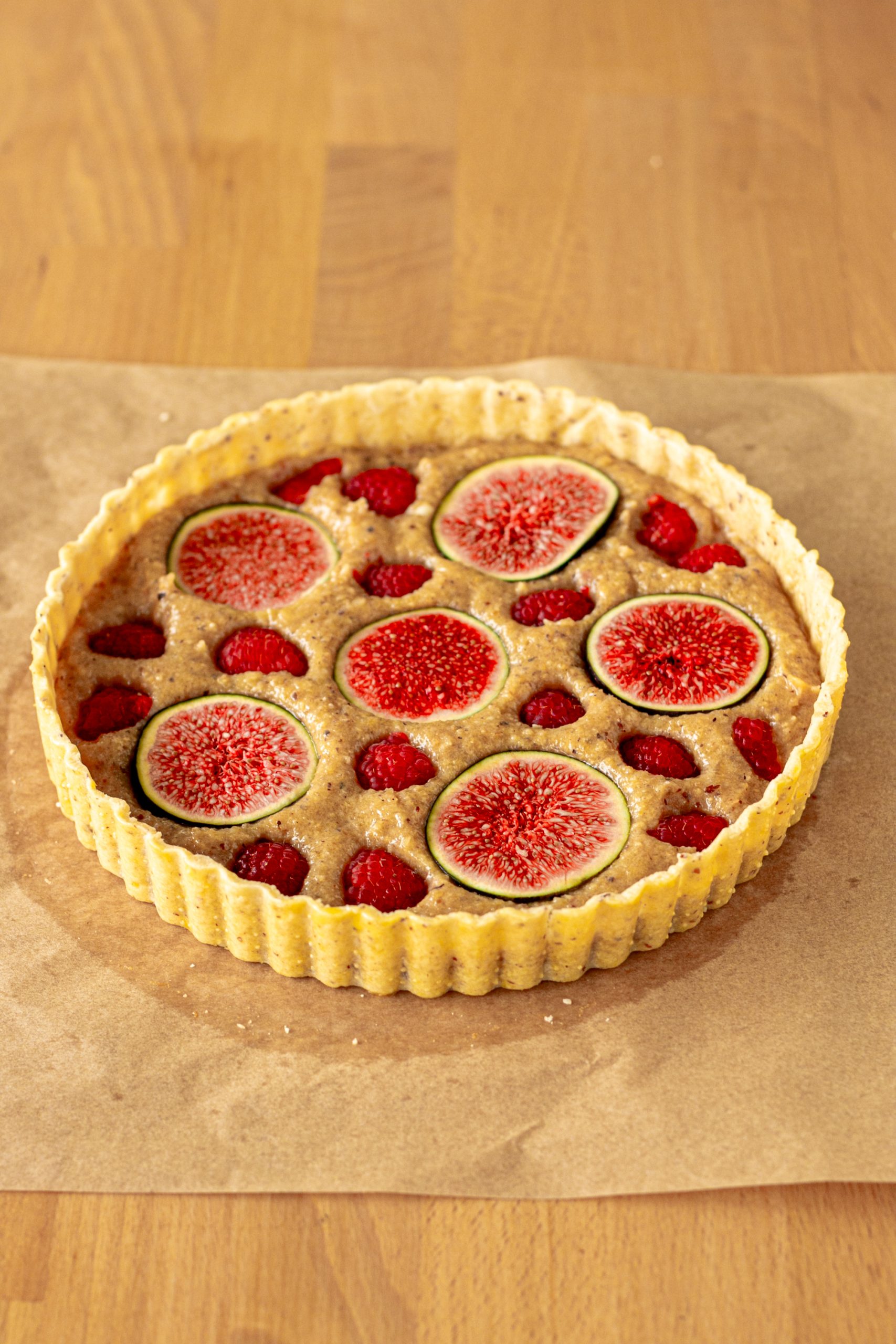
- a few figs and raspberries
Method
1
Meanwhile, beat the butter in the stand mixer (with paddle attachment) to a cream.
2
Add the sifted icing sugar and mix.
3
Fold in half the eggs. Mix then fold in half the ground almonds. Mix again.
4
Add the remaining eggs and mix, then add the remaining ground almonds and the flour. Mix until you have a smooth, homogeneous cream.
5
After 15 minutes of baking, remove the tart from the oven and leave to cool slightly.
6
Smooth out any imperfections in the pastry with a microplane grater.
7
Pipe the hazelnut cream into the tart shell, taking care to distribute it evenly (don’t add too much as it will expand during baking), then arrange blueberries in the hazelnut cream at regular intervals.
8
Bake for approximately 15 minutes at 160°C / 325°F (the hazelnut cream should be lightly golden and soft). The sweet pastry should be nicely golden. 10 minutes before the end of baking (when the ring has come away from the tart), you can brush it with a mixture of egg yolk and double cream for a shiny tart shell. Once out of the oven, set the tart shell to cool on a wire rack. Set aside.
Assembly
Ingredients
- None
Method
1
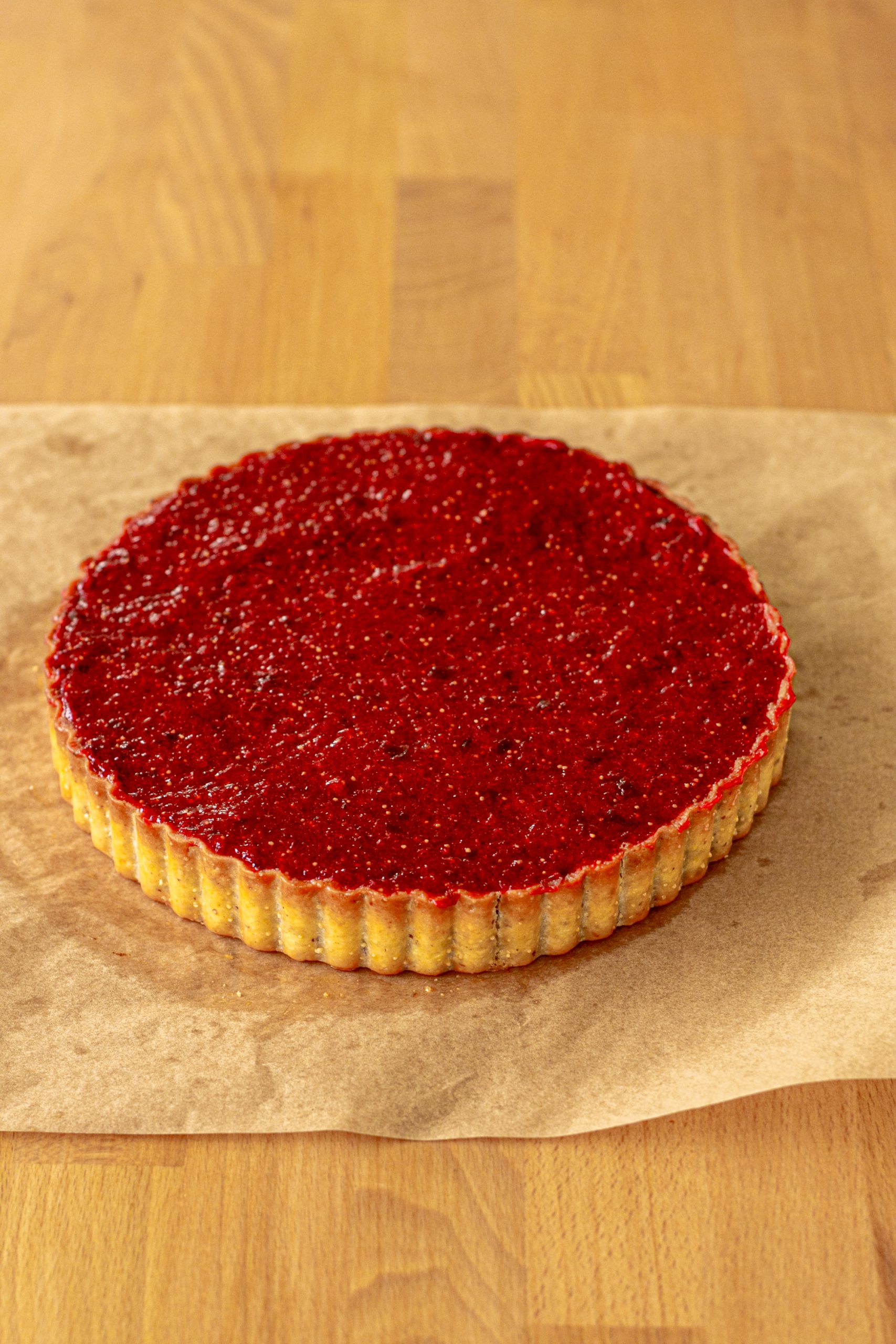
Loosen the fig and raspberry confit and fill the tart shell (take care to keep the equivalent of 1 or 2 tablespoons of confit for the decoration).
2
Whip the ganache like a Chantilly, firm enough to be piped but not too stiff, then place in a piping bag fitted with a nozzle.
3
First pipe the whipped ganache around the edge with small back-and-forth motions, then gradually work inwards (I made 3 circles of cream). Also add some whipped ganache in the centre so the fruits sit well afterwards.
4
Cut the figs into quarters or eighths and arrange them delicately in the centre of the tart with the raspberries.
5
Fill the raspberries with the remaining confit, then add a few halved hazelnuts and hazelnut skins (if you have them).
6
Set aside in the fridge until ready to serve.

Gallery