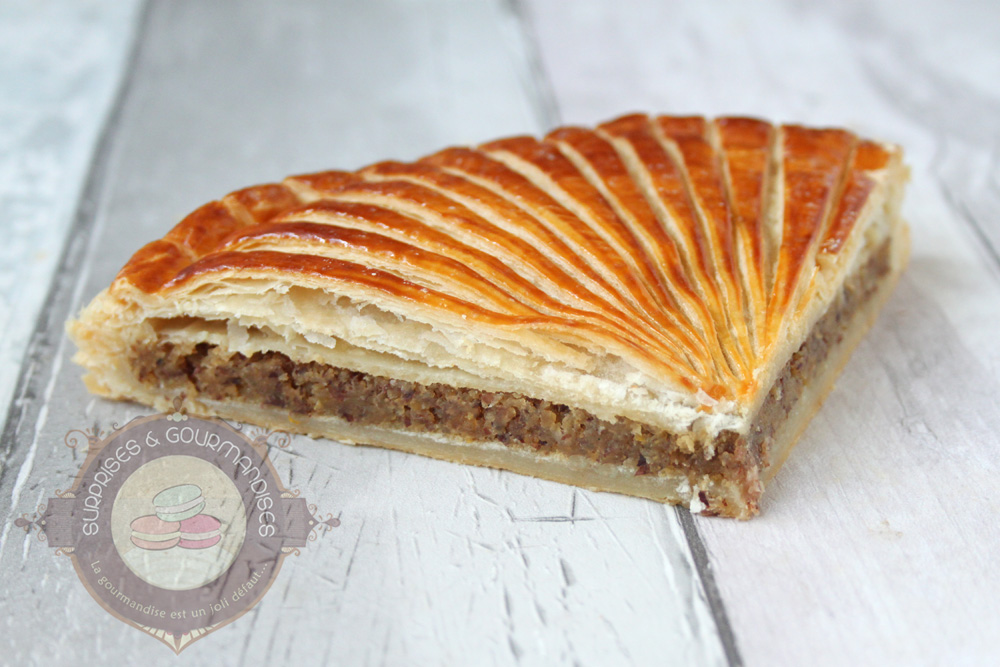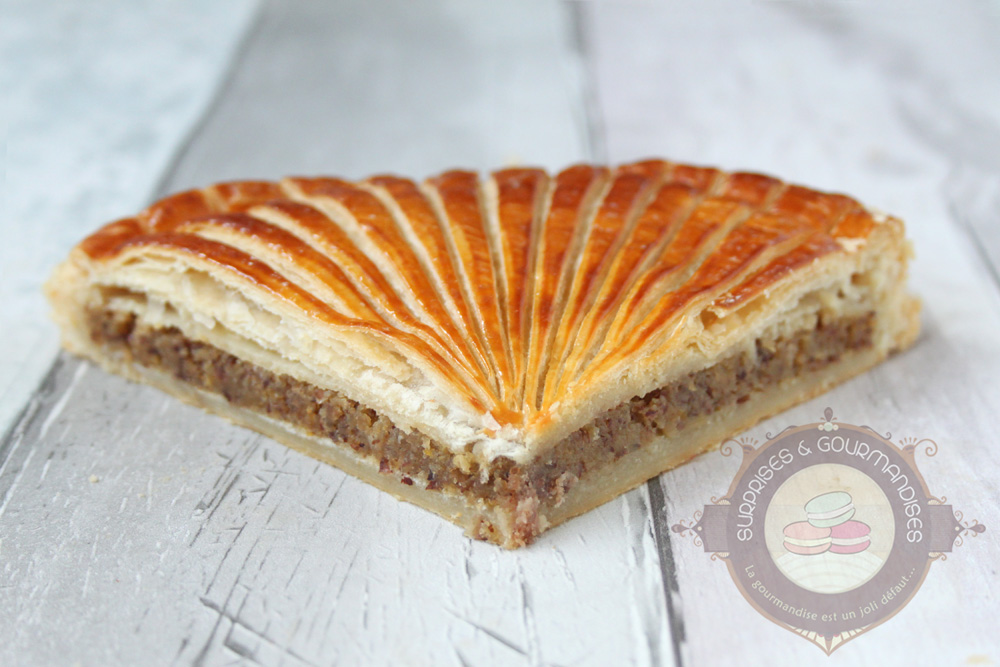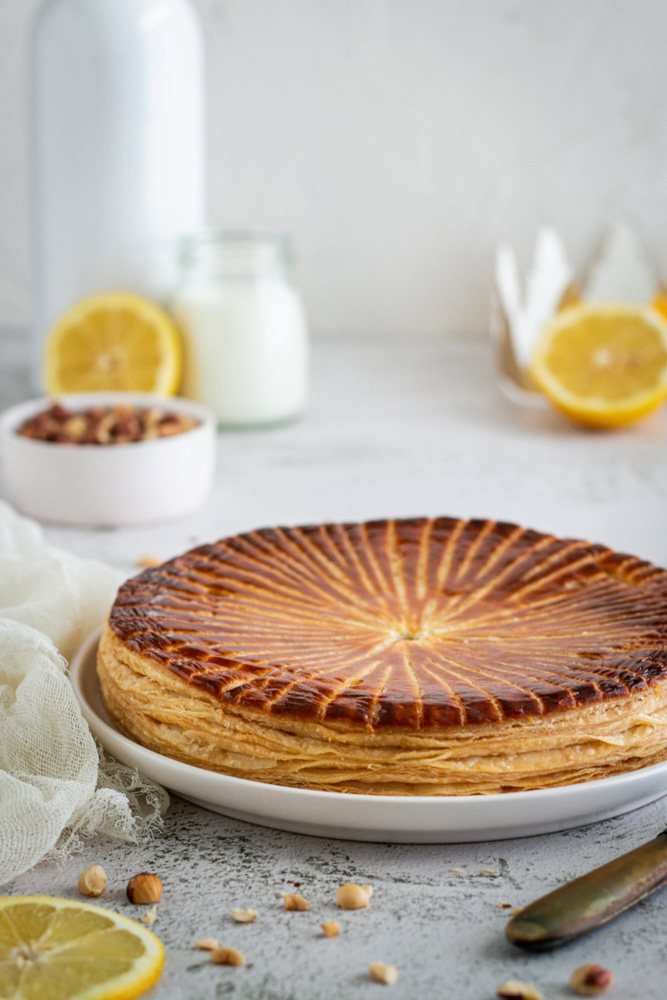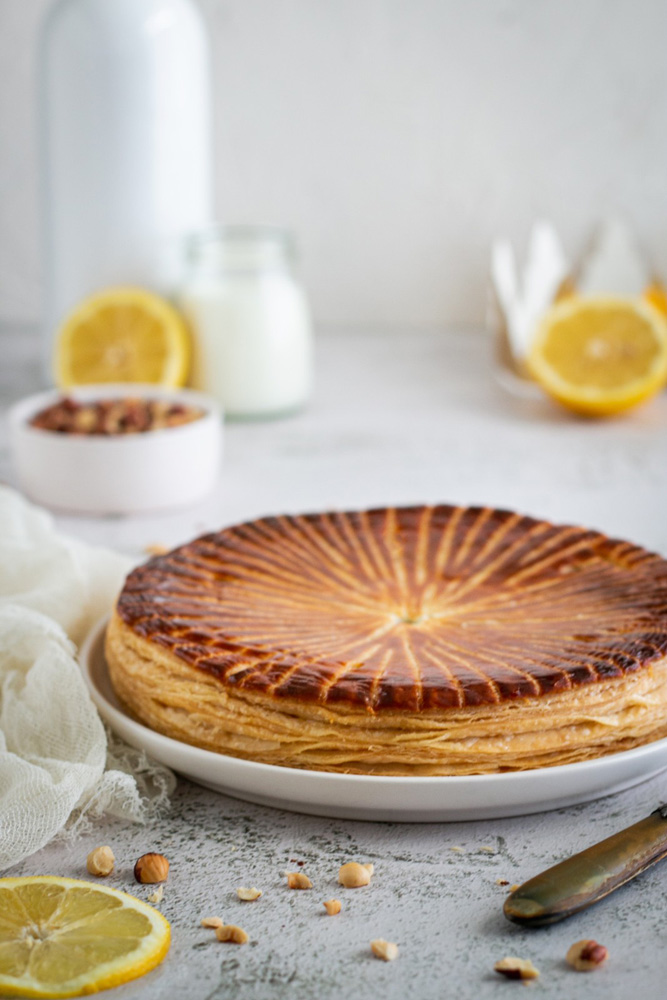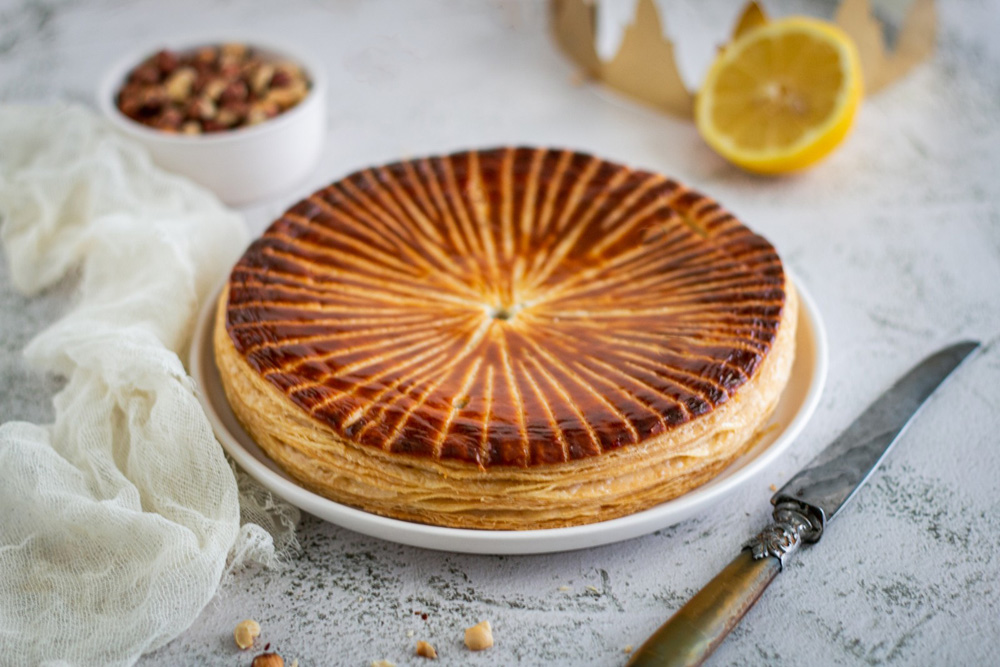



With the excitement of Christmas behind us, we turn the page on Yule logs and dive into the galette des rois (King cake)!
Epiphany is approaching, and with it, the traditional galette des rois and the famous puff pastry. Clearly, bread-making and I are not really friends. That’s actually why you won’t find recipes for brioche, croissants, pains au chocolat and so on on my blog. Of course, I’ve already tried my hand at puff pastry, and it actually turned out pretty well. But it takes so long to make! Still, this year I motivated myself and set myself the challenge of making all the puff pastry for my next galettes.
First, let’s make a clear distinction between puff pastry and inverse puff pastry. The principle of inverse puff pastry is that the détrempe is on the inside and the “beurre manié” on the outside, i.e. the opposite of a classic puff pastry. Here I followed Christophe Felder’s inverse puff pastry recipe with the video tips from La pâte de Dom.
Strangely, and contrary to what you might think, inverse puff pastry is easier to make than classic puff pastry because it’s also easier to work with. What’s more, the butter can’t escape since it’s on the outside, so there are fewer complications. When you taste it, the difference is striking. Inverse puff pastry is incredibly melt-in-the-mouth, a real delight!
We also owe the hazelnut frangipane recipe to Christophe Felder. You can find it in his magnificent book entitled “Galettes”. I just added some lemon zest to it.
This time too, I wanted a galette with perfect edges, without any trace of crimping (crimping is when you mark the edges of the galette with the back of a knife so that the two discs of pastry seal together perfectly).
I can’t tell you how stressed I was during baking; I was so afraid the frangipane would make a run for it! But it was perfect! I think it’s so much prettier like this ???? And so that it’s evenly tall, when baking, I place a sheet of baking paper on the galette and then the drip tray on the shelf above, which gives it a few centimetres to rise. Of course, I remove the drip tray before the end of baking so that it can brown.
Obviously, we all know the traditional galette recipe made with almond frangipane. By the way, I’ll take this opportunity to remind you that frangipane is a mixture of almond cream and pastry cream (generally 1/3 pastry cream and 2/3 almond cream). The pithiviers, on the other hand, is made solely of almond cream. Anyway, I’ve already made almond frangipane countless times, so this year I wanted to change my habits a little.
So I set off with the idea of pairing hazelnut and lemon (a pairing that needs no introduction). Originally, I wanted to make a hazelnut frangipane and a lemon confit to add some zing. Except that I messed up my lemon confit… so I added the zest of a lemon to my frangipane and the flavour was there. You could really taste both the hazelnut and the lemon. No regrets! I really loved this galette, which is why I’m sharing this recipe. The presence of lemon may be a little unsettling, especially if you’re a fan of the traditional almond galette. But there’s no harm in discovering new things, is there?
Ingredients & method
4 components · Full recipe
Pastry cream (you’ll have some left over, but you can make another king cake)
Ingredients
- 125 g (4.4 oz) milk (whole, preferably)
- 30 g (1.1 oz) sugar
- 30 g (1.1 oz) egg yolks (2 yolks)
- 12 g (0.4 oz) cornflour
- 12 g (0.4 oz) butter
- 1/2 vanilla pod
Method
1
In a small saucepan, heat the milk with the half vanilla pod, split and scraped, and half the sugar.
2
In a bowl, add the egg yolks and the remaining sugar, then beat until the mixture lightens in color.
3
Add the cornstarch and mix.
4
Pour half of the hot milk in a thin stream, whisking continuously, to temper the cream. Pour everything back into the saucepan.
5
Whisk over medium heat until the cream thickens, about 2 minutes.
6
Off the heat, add the butter and mix vigorously.
7
Transfer to a shallow dish and press plastic wrap directly onto the surface. Cool rapidly (the faster the cooling, the longer the pastry cream will keep).
Hazelnut and lemon cream
Ingredients
- 65 g (2.3 oz) icing sugar
- 1 egg
- 65 g (2.3 oz) ground hazelnuts
- 50 g (1.8 oz) softened butter
- 15 g (0.5 oz) hazelnut paste (or, as I did, hazelnut praline)
- 5 g (0.2 oz) cornflour
- zest of 1 lemon
- 1 pinch of fleur de sel
Method
1
Place the softened butter in a bowl and work it first with a spatula to loosen it, then use a whisk to obtain a smooth, creamy texture.
2
Add the hazelnut paste (or hazelnut praline), cornstarch and egg. Mix with a whisk.
3
Then add the sifted powdered sugar, lemon zest and hazelnut flour.
4
Mix with a rubber spatula to obtain a smooth paste but do not whisk for too long. Refrigerate.
Hazelnut and lemon frangipane cream
Ingredients
- the hazelnut and lemon cream from above
- 65 g (2.3 oz) pastry cream
Method
1
In a bowl, smooth the cooled pastry cream with a whisk.
2
Fold in the hazelnut lemon cream and mix quickly. If you whisk the frangipane for too long, it will puff up during baking.
3
Place the frangipane cream in a piping bag fitted with a 1 cm (0.4 in) plain nozzle. Refrigerate until assembly.
Assembling the hazelnut and lemon king cake
Ingredients
- 2 discs of reverse puff pastry (or 2 store-bought puff pastry sheets)
- the hazelnut and lemon frangipane cream
- sugar syrup
- 1 fève (hidden charm)
Method
1
Cut out 2 rounds of inverted puff pastry measuring 24 cm (9.4 in) in diameter.
2
Place a pastry disc on a sheet of parchment paper, itself placed on a baking tray (it will be much easier to move it later).
3
Pipe the hazelnut lemon frangipane in a circle starting from the center of the galette. Leave about 3 cm (1.2 in) free around the edge.
4
Place the bean towards the outside.
5
Using a pastry brush, moisten the edges of the galette with a little water on the 3 cm (1.2 in) of free space you left. Carefully place the second pastry sheet on top and position the upper layer correctly.
6
Carefully cover with the second round of puff pastry, making sure the two pastry pieces are properly aligned.
7
Seal the two pastry discs together by pressing lightly and being careful to push the frangipane inward. You can crimp the pastry with a knife to prevent the galette from opening during baking.
8
Remove the galette and turn it over, flat side up (the rounded side is therefore in contact with the parchment paper).
9
Mix one egg yolk with a very small amount of liquid cream (generally 4 g (0.1 oz) of cream per yolk).
10
Brush the top of the galette with egg wash a first time and rest in the refrigerator for about twenty minutes. Brush a second time and refrigerate while preheating the oven. Be careful not to brush the sides, as this prevents the pastry from puffing up properly.
11
Remove the galette from the refrigerator and pierce a hole right in the center so that steam can escape.
12
Decorate the top of the galette with the back of a knife, using the hole in the centre as your starting point.
13
Bake the galette for approximately 35–40 minutes, then reduce the oven temperature to 160°C / 325°F and bake for a further 5 minutes. Keep a close eye on the last few minutes of baking to prevent the top from burning. Allow to cool before serving.
14
While the galette is baking, prepare a simple syrup (20 g (0.7 oz) water, 20 g (0.7 oz) sugar brought to a boil in a saucepan then left to cool).
15
As soon as it comes out of the oven, brush the top of the galette with this syrup and leave to cool on a rack.

Gallery