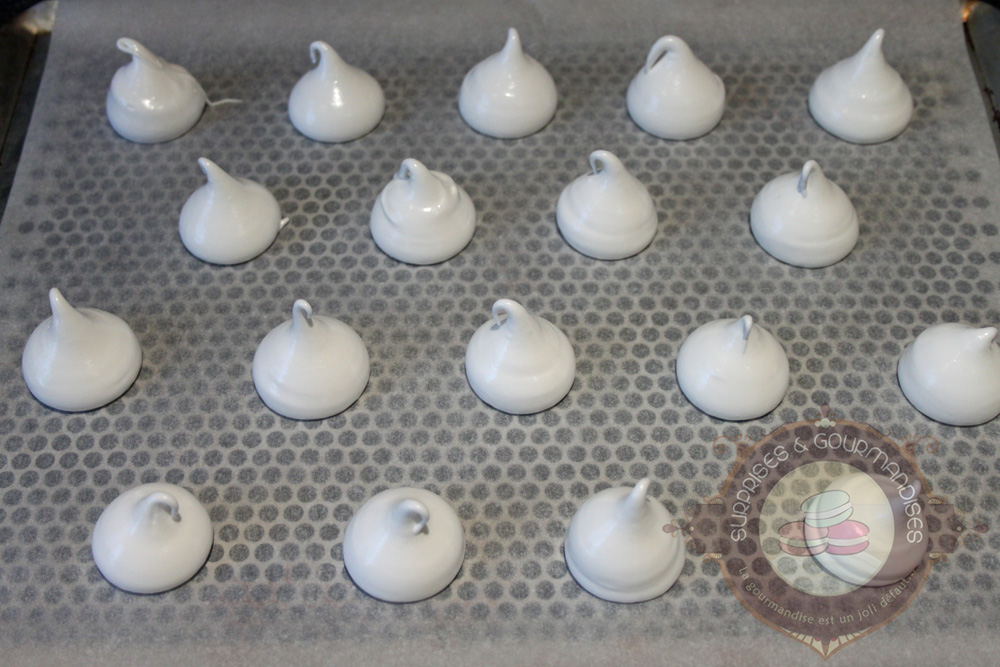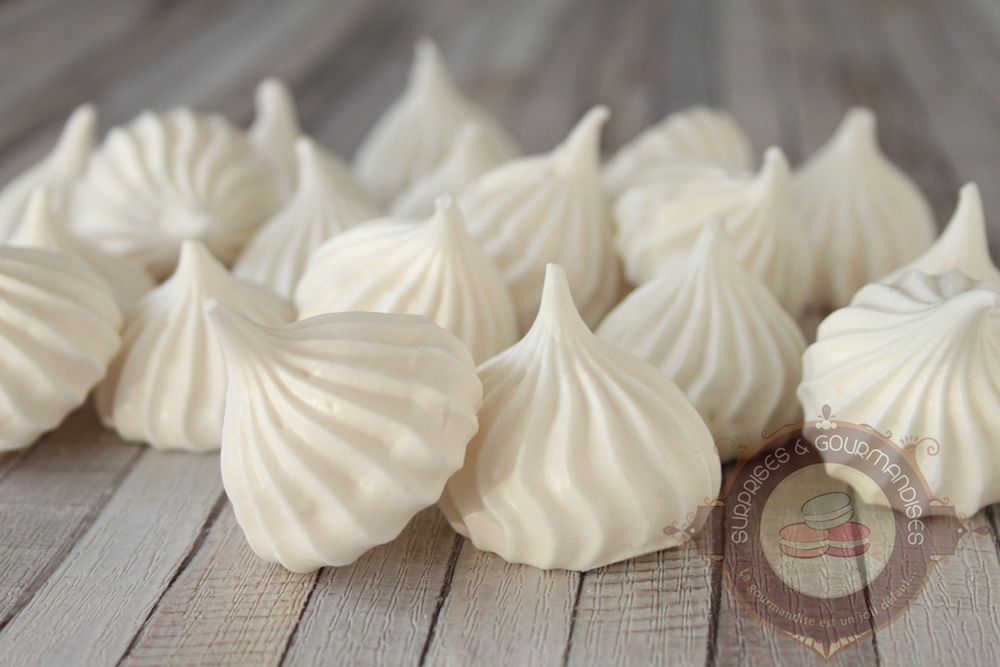



If you have leftover egg whites and don’t want to embark on making macarons (it’s not always easy to do, let’s admit it), then make meringues. They’re simple and quick to make (the baking is longer but not the preparation).
And if you still have lots of egg whites left (I always have a tonne in my fridge), I recommend this vanilla loaf cake recipe simply entitled “Vanilla loaf cake inspired by Maxime Frédéric (or how to get rid of a heap of egg whites)”. As well as being delicious, this recipe will let you use up close to 300 g of egg whites.
If you ever want to brighten up your meringues a little, you can add a little water-soluble colouring when you whip the egg whites. You can also add decorative elements such as little sugar pearls, stars or hearts (to be done before baking of course).
How do I get my meringue right?
- The egg whites must be at room temperature (it’s the same as for macarons).
- I advise you not to bake above 100°C or the meringue may turn yellow (which isn’t very pretty). The ideal in my opinion, after many attempts, is baking at 80°C. Not only does my meringue stay white but it also doesn’t crack.
- When you start whipping the egg whites, don’t add the sugar too early. You’d end up with a meringue that isn’t firm enough and you’d struggle to pipe it onto a baking sheet.
- Once you’ve added the sugar (gradually, mind you!), keep beating your egg whites. This is what’s called “tightening the whites”. The meringue will then be firm and you’ll get the famous “bird’s beak”.
How do I store my meringues?
Once the meringues are baked, let them cool completely. I then advise you to store them carefully in an airtight container or a tin. In theory, meringues keep this way, at room temperature, for 2 weeks. Personally, I’ve never had the time to try, they disappear too fast 😉
Ingredients & preparation
1 component · Complete recipe
Meringues
Ingredients
- 120 g (4.2 oz) egg whites (approximately 4 whites)
- 120 g (4.2 oz) caster sugar
- 120 g (4.2 oz) icing sugar
Instructions
1
Preheat the oven to 80°C / 176°F.
2
Separate the whites from the yolks. Ideally the whites should be at room temperature.
3
Begin whisking the whites with an electric mixer or stand mixer on low speed to incorporate as much air as possible. The whites will start to foam.
4
Add the caster sugar gradually once the whites have already started to stiffen. Continue whisking to firm up the meringue. When you lift the whisk from the meringue, a bird’s beak should form.
5
Add the sifted icing sugar and fold in gently with a spatula.
6
Transfer the mixture to a piping bag fitted with a plain or star nozzle, as you prefer.
7
Line a baking tray with parchment paper and pipe small mounds of meringue in a staggered pattern.
8
Bake for approximately 2 hours, depending on the size of the meringues. You can leave them in the switched-off oven to dry out further.

Gallery